
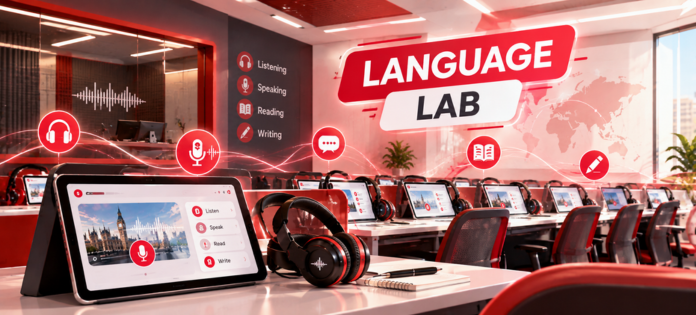
What is a Language Lab?

A language lab is a structured learning environment where students develop language skills through guided listening, speaking, reading, and writing practice. Traditional language laboratories used audio equipment to help students listen to recordings, repeat sentences and improve pronunciation. Modern language labs combine teacher-led instruction with digital activities, interactive exercises, assessments and, in some programmes, AI-supported speaking practice.
The idea of a language lab is also much older than digital learning: dedicated language-laboratory setups can be traced back to the early 1900s, when phonographs and listening equipment were used for language practice. Over time, the technology changed, and so did the ways students could practise a language.
That evolution is especially relevant in schools, where language learning involves regular practice across listening, speaking, reading and writing. A language lab can complement regular lessons by creating additional opportunities for individual practice, communication, feedback and progress tracking.
This guide explains what a language lab is, how it works, the skills students practise and the activities commonly used in a modern language lab. It also looks at how language labs have developed from traditional audio-based laboratories into broader learning environments.
What Is a Language Lab?
The term “language laboratory” originally referred to a dedicated room where students used equipment to practise listening and speaking in a foreign language. Cambridge Dictionary defines a language laboratory as a room in a school or college where students use equipment to practise listening to and speaking a foreign language.
Today, language labs cover a much wider range of learning activities. A modern language lab can include audio and video content, interactive exercises, speaking activities, assessments, digital course material and technology-assisted feedback.
The central purpose remains language practice. Students are given structured activities that allow them to actively work with the language instead of spending the entire lesson receiving information.
How Does a Language Lab Work?
A language lab generally brings together three parts of the learning process: instruction, practice, and assessment.
A teacher or facilitator introduces a concept or activity, after which students work through guided practice individually, in pairs, or in groups. Their work can then be assessed to identify progress and areas that need further practice.
Liqvid’s English Language Lab follows this structure through Instructor-Led Training (ILT), Self-Paced Learning (SPL), and a Coursebook. ILT supports classroom instruction and communication practice, SPL provides independent learning with AI-supported speaking activities and assessments, and the coursebook provides structured, curriculum-aligned practice.
What Skills Are Practised in a Language Lab?
Language learning involves several connected skills. A language lab can bring these skills into regular practice through different activities.
1. Listening
Students listen to conversations, instructions, dialogues or other recorded material and work on understanding spoken language.
2. Speaking
Students practise pronunciation, fluency, accuracy and everyday communication through speaking exercises, conversations and role plays.
This is often where students need the most practice. Knowing the right words on paper can feel very different from actually using them in a conversation.
3. Reading
Reading activities help students understand written passages, recognise vocabulary and develop reading fluency.
4. Writing
Students can practise sentence formation, vocabulary, grammar and written communication through structured exercises.
Language labs can also support vocabulary, pronunciation, grammar, critical thinking and broader communication skills. Liqvid’s school language lab identifies speaking, listening, reading, writing, vocabulary, communication and critical thinking among the skills developed through its programme.
What Activities Are Included in a Language Lab?
The exact activities depend on the programme and age group, but language labs commonly use a mixture of individual and collaborative practice.
A student may listen to a conversation and answer questions, practise pronunciation, complete a vocabulary exercise, read a passage aloud, participate in a role play or respond to a speaking prompt. Group discussions and presentations can also be used when the lesson requires collaborative communication.
Technology can add another layer to these activities. For example, Liqvid’s English Language Lab includes AI-powered speaking practice, instant assessments and progress tracking within its self-paced learning component. Its school programme also includes activities such as role plays and read-aloud exercises.
The activities therefore vary, while the underlying purpose stays consistent: students need regular opportunities to practise using the language. The idea is quite straightforward: students learn something, try it themselves, and get another chance to practise it.
How Is a Modern Language Lab Different from a Traditional Language Laboratory?
The biggest difference lies in the range of learning activities available.
Traditional language laboratories were primarily designed around audio-based practice, with students listening to recordings and responding through dedicated equipment.
Modern language labs have expanded this model to support multiple forms of language practice. Digital content, interactive exercises, assessments, multimedia resources, and AI-supported activities can now be part of the learning environment.
Liqvid’s English Language Lab reflects this broader approach by combining Instructor-Led Training, self-paced learning, and coursebook-based learning with AI-supported speaking practice and assessments within its self-paced component.