
How Publishers Can Monetize Digital Content

The global digital content market is expanding at a pace that few industries have seen before. According to Grand View Research, the global e-learning market alone is projected to exceed $800 billion by 2030. Add to that the broader digital publishing, media, and content licensing sectors, and the revenue opportunity for publishers becomes even larger, yet most of it remains untapped. This indicates a clear pattern: content creation is widespread, but effective monetization remains uneven.
Many publishers have successfully digitized their content, but monetization models have not evolved at the same pace. Revenue often depends on single transactions, basic pricing, or loosely structured access. As a result, content gets used multiple times, but earnings remain tied to limited entry points instead of continuous usage.
What makes digital content fundamentally different from physical content is its ability to generate revenue across its entire lifecycle. It can be accessed repeatedly, updated without additional production cost, and consumed across formats and devices. A textbook publisher in London, a professional training provider in Singapore, or an independent course creator in Nairobi all face the same structural opportunity: the same content, if organized correctly, can produce consistent revenue over months or years instead of a one-time return.
This blog explains how to structure monetization in a way that reflects how digital content is actually consumed. It covers practical revenue models, factors that influence earnings, common mistakes, and approaches that help build a more stable and scalable income system.
How to Improve Revenue from Digital Content
Improving revenue from digital content requires structuring it for repeated use and flexible access. When content is organized based on how users consume it, the same material starts generating value across multiple interactions instead of a single transaction.
• Move from Physical Thinking to Usage-Based Structuring
Revenue logic changes when content is treated based on usage rather than units. Publishers who built their business around print often default to the same one-unit, one-sale model when they go digital and that is where their revenue gets capped. Breaking content into modules, sections, or learning paths creates multiple access points.
A single book or course can be reorganized into smaller units. A 200-page professional guide, for instance, can become a library of 15 to 20 focused modules, each priced and distributed independently. These units can be offered separately, combined in different formats, or updated over time. This allows the same content to support multiple revenue streams without requiring new creation.
• Reduce Dependence on One-Time Sales
One-time sales restrict revenue to a single transaction. Digital content continues to be accessed after purchase, but that extended usage does not contribute to additional earnings.
A user who pays once for a certification guide and then returns to it six times over three months has generated exactly the same revenue as someone who opened it once. That is the gap between usage and earning where most publishers lose money. Creating multiple earning points for the same user allows revenue to grow with continued interaction. This improves overall value per user without increasing content volume.
• Align Content Access with User Needs
Revenue improves when content is offered in a way that matches how different users prefer to access it. A corporate L&D manager buying licenses for 500 employees has entirely different access needs compared to a freelance professional looking for one specific skill module. Some users look for complete programs, while others prefer focused topics or shorter formats.
Structuring access around these patterns increases the chances of conversion. It allows the same content to serve different use cases without creating new material.
How to Monetize Digital Content Effectively
Monetization depends on how content is structured and offered to users. Clear models aligned with usage patterns and buying behavior help generate consistent and scalable revenue.
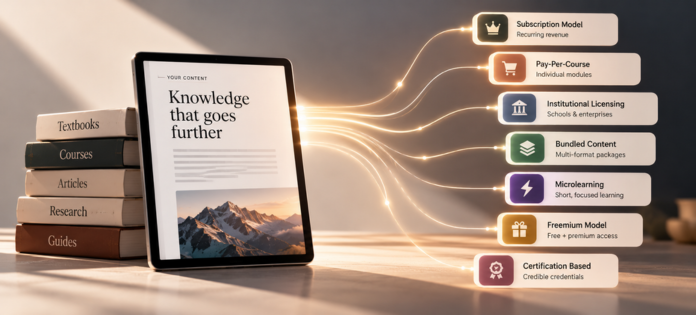
• Subscription Model
In many learning scenarios, users don’t consume content in one go. They come back, pause, revisit, and continue over time. This behavior naturally supports a model where access remains open instead of being restricted to a single purchase.
The subscription model works by providing continuous access to content for a recurring fee. It performs particularly well in areas like language learning, compliance training, test preparation, and professional skill development, categories where the content itself needs to evolve alongside industry standards or exam syllabi. When content keeps expanding or updating, users find value in staying connected, which builds steady and predictable revenue over time. Many publishers such as O’Reilly have demonstrated at scale that a well-managed subscription library can generate more consistent revenue than the same content sold individually.
• Pay-Per-Course or Module Model
Some users approach content with a clear and immediate goal. They are not exploring broadly, they are trying to solve a specific problem or learn a defined skill. In such cases, access to an entire library becomes unnecessary.
This is where selling individual courses or modules becomes effective. A project manager looking for a course on stakeholder communication does not need a full business curriculum. The model works by pricing each unit of content separately, allowing users to pay only for what they need. Publishers often see stronger conversion rates when content is clearly outcome-driven, like clear title, defined skill, stated duration, this is because the value is easy to understand at the point of purchase.
• Institutional Licensing Model
In many cases, the end user is not the buyer. Schools, companies, and organizations often need content for multiple people at once, and they look for structured solutions rather than individual purchases.
The licensing model works by offering bulk access to institutions for a fixed fee or contract. A single enterprise deal can replace hundreds of individual transactions, with contract values ranging from thousands to millions depending on organization size and content scope. For publishers, this creates larger deal sizes and more stable revenue cycles. It also shifts the focus from individual conversion to long-term partnerships. In regulated industries such as healthcare, finance, and aviation, institutional licensing is often the primary revenue channel because compliance training is mandatory across entire workforces.
• Bundled Content Model
Content often performs better when different formats support each other. A learner reading theory may need practice, interaction, or updates alongside it to fully understand the subject.
Bundling works by combining formats into one offering. A medical publisher, for example, might combine a reference guide with case-based assessments and monthly clinical updates, delivering a complete learning experience rather than isolated content. Instead of treating each format separately, the experience is built as a single package. This increases perceived value and allows better pricing without creating entirely new content.
• Microlearning Model
A large segment of users, particularly in Asia-Pacific and African markets where mobile is the primary access device, prefers short, focused learning instead of long sessions. Time constraints, mobile usage, and immediate needs shape how content is consumed across many regions.
Microlearning addresses this by delivering content in small, standalone units. Each unit typically covers one concept in five to ten minutes and can be consumed during a commute, between meetings, or in any fragmented window of time. This model increases accessibility and creates more entry points for users. Over time, multiple small interactions contribute to meaningful engagement and revenue.
• Freemium Model
A large number of users prefer to explore content before paying for it. They want to understand the quality, relevance, and usefulness before making a decision.
The freemium model works by offering a portion of content for free while keeping advanced or complete access paid. Duolingo built an audience of over 500 million registered users on this principle, free access at the core, with premium features driving subscription revenue. Free content attracts users and builds trust. Once users find value, a share of them convert into paying customers. The model works best when the free layer is genuinely useful but stops short of delivering the full outcome, leaving a clear, logical reason to upgrade.
• Certification-Based Model
In many cases, the value of content increases when it leads to a recognized outcome. Learners often look for proof of completion or validation of their skills.
This model works by charging for certification, assessments, or exams linked to the content. Coursera’s professional certificate programs, many offered in partnership with Google, IBM, and Meta, have demonstrated that learners pay significantly more when a credential carries real employment weight. Access to learning material may be free or subsidized, but the final credential becomes the primary monetization point. It works well in professional learning, skill development, and career-focused content where outcomes matter directly to hiring and promotion decisions.
• Advertising and Sponsorship Model
Content with high user traffic often attracts brands and partners looking for visibility. This becomes relevant when content reaches a large and consistent audience.
The model works by allowing advertisements, sponsored content, or brand integrations within the platform. A publisher running a high-traffic legal education platform, for instance, might attract sponsorships from law firms, legal tech companies, or bar exam prep services, all of whose audiences align directly with the content. Revenue depends on audience size, engagement, and niche relevance. It is more effective for publishers with strong reach, where content consumption itself becomes valuable for external partners.
How to Increase Revenue from Existing Content
Increasing revenue from existing content depends on how consistently it is used and how effectively it is structured for ongoing access. Content that remains active across multiple interactions continues to generate value over time.
• Keep Users Actively Engaged
Passive content, material that a user downloads and puts aside, generates no further revenue. Content that includes structured learning paths, embedded assessments, and clear next-step prompts keeps users moving through the material instead of dropping off. Higher engagement levels contribute directly to stronger revenue outcomes by increasing the likelihood of continued access and further content exploration.
A publisher tracking module-level completion data can identify exactly where users stop, and fix it. That kind of operational insight turns content management into a revenue lever.
• Improve Content Completion
Completion reflects how effectively content delivers its intended outcome. When users move through content in a structured way and reach the end, it strengthens their perception of value and their willingness to purchase the next module, renew a subscription, or recommend the content to others.
Breaking long-form content into sections of 10 to 15 minutes, with clear milestones at each stage, has been shown to improve completion rates significantly across digital learning platforms. This leads to better user satisfaction and supports ongoing monetization.
• Build Repeat Usage
Content that connects topics and maintains continuity encourages users to return. Structured progression across modules and regular updates create multiple points of interaction over time.
Repeat usage increases overall content consumption and expands opportunities for generating revenue from the same user base.
• Maintain Content Consistency
Content that becomes outdated loses authority quickly. A compliance training module referencing superseded regulations, or a finance guide using three-year-old market data, signals poor quality to users and institutions alike. Regular updates and additions support ongoing relevance and usability. Publishers who commit to annual or biannual content reviews maintain the kind of trust that institutional buyers and individual subscribers renew without hesitation.
Building a Sustainable Revenue Model
Sustainable revenue comes from combining the right monetization models with how content is actually used. Structured access, clear formats, and repeated usage create multiple points of value from the same content.
The publishers seeing the strongest long-term returns are the ones who have built systems around their content. When content stays active, gets completed, and brings users back, it continues to generate revenue over time. A well-defined approach turns content into an ongoing revenue system rather than a one-time transaction.
Start monetizing your digital content the right way. Structure it for repeated use, choose the models that match your audience, and build a revenue system that grows over time, not just at the point of sale.