
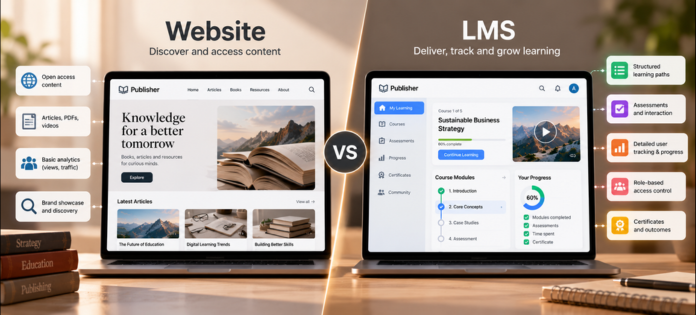
LMS vs Website for Publishers: What Do You Really Need?

Websites have been the primary digital layer for publishers. They bring content online, make it discoverable, and allow users to access information across devices and regions. This structure has supported digital publishing at scale for a long time.
According to the WAN-IFRA World Press Trends Outlook 2024–2025, digital revenue now accounts for more than 30% of total publisher revenue, up 7 percentage points in a single year. As content consumption shifts, the systems publishers use to deliver that content are being tested in ways a standard website was never built to handle.
As content usage becomes more structured, this setup starts to show its limitations. In use cases such as professional training, certification programs, or multi-level learning content, users move through material in defined sequences, revisit sections, and expect clarity in how content is organized and delivered.
This blog breaks down how websites and learning management systems handle content differently in real publishing scenarios. It focuses on how each system supports user interaction, content flow, and overall experience, making it easier to understand where each fits in a practical setup.
How Websites and LMS Platforms Differ in Real Publishing Use
The differences between a website and a learning system become clearer when viewed side by side. Each handles content, user interaction, and delivery in a distinct way. Looking at them in a structured comparison makes it easier to understand how each fits into real publishing use.
The following sections present these differences in a consistent format, focusing on how content is accessed, used, and managed across both systems.
1. Content Access vs Structured Flow
A website presents content in a way that allows users to access information freely. Pages are structured for navigation, and users decide what to open, skip, or revisit. A publisher might host articles, PDFs, or videos across different sections, and the experience depends entirely on how the user moves through them. This works well for discovery and reference, where the goal is to make information available.
An LMS structures content into a defined flow. Users enter a course or program and move step by step through modules. Each section connects to the next, creating a clear sequence. In a certification program or professional training setup, this structure ensures that content is consumed in the intended order, rather than randomly.
A medical publisher delivering compliance training, for example, needs learners to complete foundational modules before accessing advanced content, a website cannot enforce that sequence, but an LMS does it by default.
2. Passive Consumption vs Interactive Learning
On a website, interaction remains limited to reading, viewing, or downloading. Even when content is detailed, there is no built-in mechanism to guide what happens after a user finishes one piece. The experience ends at consumption.
An LMS introduces interaction as part of the experience. Users engage through assessments, checkpoints, and progress-based movement. Pearson’s MePro platform is a direct example that learners move through structured modules with assessments at each stage, and progression depends on demonstrated understanding, not just access. A website interface could not have delivered that experience. A publisher delivering leadership development content to enterprise clients can build in assessments at each stage, ensuring the content is not just accessed but actually retained and applied. This level of interaction becomes part of how content is delivered.
3. Basic Metrics Visibility vs Detailed User-Level Tracking and Progress Insights
A website provides high-level visibility into usage. Metrics such as page visits, time spent, bounce rate, or traffic sources give an overall sense of activity. These signals help identify which content attracts attention and where users are coming from. For publishers focused on reach and discovery, this level of data supports decisions around content popularity and audience behavior at a broad level. However, the visibility remains limited to aggregated patterns rather than individual usage.
An LMS tracks usage at the user level, capturing how each individual interacts with the content. It shows who started a course, where they paused, how much time was spent on each module, and whether the content was completed. Scholastic experienced this shift when they moved beyond website traffic data to user-level reading behaviour on their digital platform like completion rates, time spent per title, and return frequency gave them the operational intelligence to decide which content to develop next. Traffic reports told them what was popular. The platform told them what was actually working. A publisher delivering a professional certification programme can see exactly which learners are progressing, which are stuck on a specific module, and which have not started and act on that data in real time.
4. Controlled Access Management vs Role-Based Content Distribution
Access on a website is generally open or lightly restricted. Users can explore content without a defined boundary. This supports reach and accessibility, especially when the goal is to make content widely available. However, the structure does not define who should access what, or in what sequence. Every user sees the same layer of content, regardless of their role, requirement, or level.
An LMS allows controlled access based on users, groups, or roles. Content can be assigned, restricted, or sequenced based on specific needs. Wiley’s digital ELT programme is a practical example, different university clients received different content packages, each matched to their specific curriculum requirements. Every institution accessed only what was relevant to them, in the required sequence. Managing that level of segmentation through a website would have been operationally impossible. Each group accesses only what is relevant to them, and in the required order. This ensures consistency in delivery and avoids overlap or misuse of content.
5. Brand Presence vs Structured Learning Environment
A website reflects the publisher’s brand and acts as the entry point. It helps users discover content, understand offerings, and explore what is available at a high level. The interaction is brief and depends on how users navigate across pages. The brand is experienced through design, messaging, and content presentation.
An LMS becomes the environment where users engage with content over time. It supports structured progression, repeated interaction, and a defined learning experience. Cambridge University Press built Cambridge One precisely for this reason. Learners return to the same environment across months of study, picking up where they left off, moving through levels, and building a relationship with the platform over time. That sustained return behaviour can not happen on a content website. It is a product of how the learning environment is structured. Users return to the same interface, continue from where they left off, and move through content in a guided manner. In this setup, the brand is experienced through continuity, consistency, and usability across sessions.
Making the Right Choice for Content Delivery
Most publishers ask this question too late, after users have already struggled through content that was never built for how they were expected to use it. A website is for reach. An LMS is for outcomes. Trying to make one do the other’s job is where publishers lose time, data, and audience trust.
Know what your content is asking users to do. Build accordingly.