The printed textbook is still the core of education. Most of us grew up with it, and many learners still trust it.
But today’s learners are digital natives. They expect videos, quizzes and quick feedback. So publishers face a real question: how do you give learners that experience without giving up the value of print and the systems you already have?
The answer is not print versus digital. It is print plus digital. We call it the Connected Textbook: a printed book whose pages link to a digital world.
The publisher’s problem: from static pages to active learning
Putting a PDF online is not enough. Learners want interaction, quick responses and multimedia.
But moving fully to digital can feel risky and expensive. It means new workflows and sometimes a new business model.
That is why connecting print and digital is a strong middle path. When you add digital links to your print books, you create a stronger product that offers the best of both formats.
Your toolkit for connecting print and digital
Two simple tools can bridge the gap between your printed pages and digital content.
QR codes
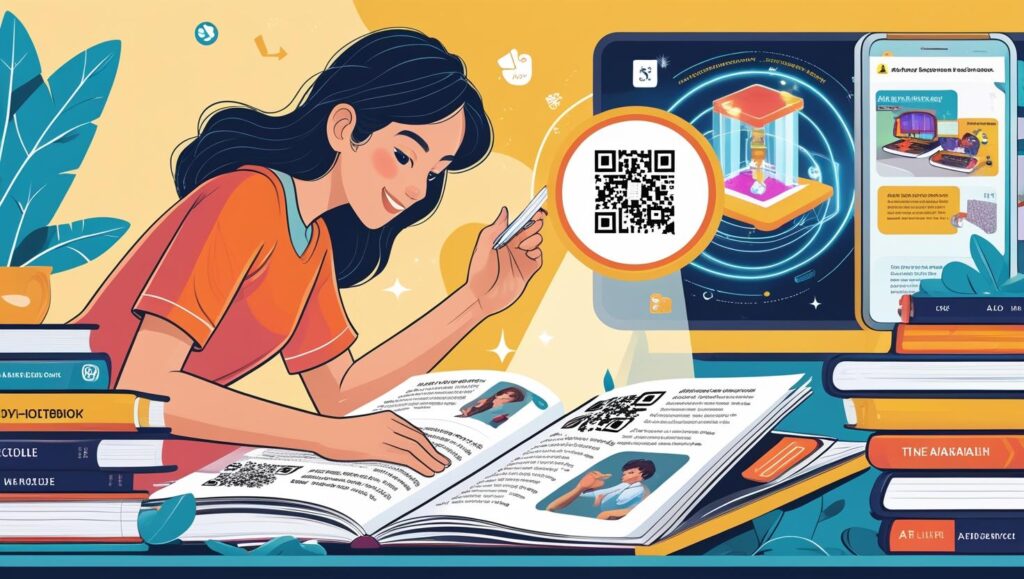
Imagine a textbook page with a QR code. A learner scans it with a phone and opens things like:
- Video explainers and animations: short, clear videos that explain a hard idea or show a science process in action.
- Interactive quizzes: quizzes linked to the lesson that test understanding and give feedback right away.
- AI-powered practice: links to AI tools that give each learner personal practice. For example, AI pronunciation correction in a new language, or smart comments on a written answer.
AR-lite experiences
AR sounds complicated, but AR-lite is simple. A learner opens a page on a smartphone and a bit of augmented reality appears on it. For example, a 3D model of a human heart, labels on a plant diagram, or a short clip of a historical event over a picture.
You do not need to build a separate app. These experiences can run on the web and open through a QR code. That keeps them easy to add to a textbook, and learners still get a “wow” moment.
Benefits of a connected textbook
Both learners and publishers gain from this hybrid model.
For learners
- More participation and better recall.
- Support for different learning styles: visual, audio and hands-on.
For publishers
- Higher product value: a connected book gives you a reason to price above competitors who still sell static books.
- Longer content life: you can update the linked digital content without a new print run.
- New data: QR code scans show which content learners use most, so you can see what interests them.
- A competitive edge: it shows your brand is modern and forward-looking.
Making the connection a reality
The idea is strong, but the work is in the execution. You need a partner who understands both teaching and technology, and who can help you plan, digitize your existing content, build custom interactive modules and bring in AI-powered tools smoothly.
At Liqvid, this is what we do. We work with publishers to turn their print catalogues into interactive learning experiences. With our AI-driven tools, ready-to-use platforms and more than two decades of experience, we help publishers make the Connected Textbook real.
The future of educational publishing is not about choosing between print and digital. It is about building one connected learning ecosystem. Let’s build it together.