
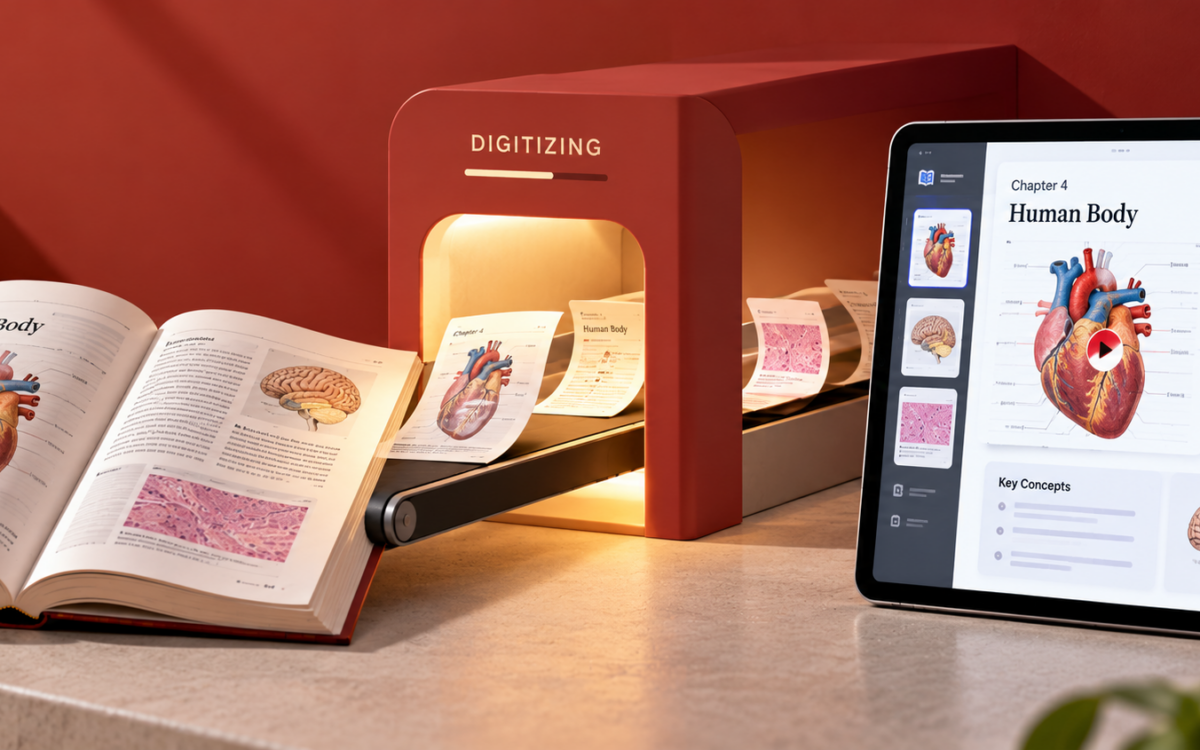
How to Digitize Educational Content for Publishers

Educational publishing is moving decisively toward digital delivery, and schools, universities and training providers increasingly expect content to arrive ready for a screen. For publishers, that raises a specific, practical question: what does it actually take to turn decades of existing textbooks, workbooks, assessments and supplementary material into something a learner can use digitally, and use well.
We work with publishers who have no shortage of content. What they’re missing is a repeatable process for converting it properly. A scanned page technically puts content online, but it changes almost nothing about what a learner can actually do with it. Digitizing content the right way means deciding how existing material gets structured, enhanced, assessed, delivered and maintained across digital platforms, in an order that avoids redoing work three steps later. That process is what the rest of this piece walks through.
How To Digitize Educational Content: Step by Step
1. Audit the existing educational content
Start with the material already available.
A publisher may have textbooks in PDF, EPUB files, scanned books, question banks, audio recordings, videos, worksheets and assessment material. These assets should be reviewed before any conversion begins.
The audit should identify:
• Which content can move directly into digital format
• Which pages require restructuring
• Where multimedia could add instructional value
• Which activities can become interactive
• Which assessments can be digitized
• What supplementary material can be connected to each chapter
• Whether content exists in multiple languages or editions
This creates a content inventory and prevents the digitization process from becoming a page-by-page conversion exercise.
2. Convert the source into structured digital content
Educational content needs structure once it moves into a digital environment.
A textbook chapter can be organised into headings, sections, text blocks, images, diagrams, activities, questions and supporting resources. This structure makes individual elements easier to display, update and reuse.
For publishers working with EPUB, the current EPUB 3.3 standard defines a format for structured and semantically enhanced digital publications using technologies such as HTML, CSS and SVG. The W3C standard specifically includes educational publications among the types of content EPUB is designed to support.
The practical objective is to create digital content that retains the logic of the original publication while making its individual components usable within a digital experience.
3. Add interactive elements to the content
Once the core material has been structured, publishers can decide where interaction belongs.
A chapter could include an embedded video, an audio explanation, an interactive exercise, a knowledge check or a chapter-level assessment. A language-learning title could include speaking activities and pronunciation practice. A science textbook could include an animation or simulation to accompany a difficult concept.
The important question is what the learner should do with a particular piece of content.
Liqvid’s Interactive E-book is designed around this approach. Publishers can use existing PDF or ePub material and turn it into interactive digital learning experiences with media, activities, assessments and AI-powered learning tools. Its system also supports customisable templates, instructor-led activities and chapter-based live tests.
4. Build multimedia around the subject matter
Digital educational content can carry forms of explanation that print cannot.
Audio narration can accompany a chapter. Video can demonstrate a process. Animation can explain a difficult concept. Images, diagrams and interactive elements can provide additional context.
Liqvid’s Smart E-Pub, for example, adds natural-voice narration, AI-generated chapter summaries and interactive MCQs to digital content. It also supports multilingual reading.
For publishers, the decision should begin with the learning objective. Multimedia works best when it adds information, explanation or practice that fits the material being taught.
5. Turn assessment material into digital activities
Assessment is another part of educational content that can be digitized.
Existing questions can become interactive MCQs, chapter tests or other digital checks. Publishers can organise assessments around individual chapters or learning units, allowing learners to test their understanding while progressing through the material.
Liqvid’s Interactive E-book allows teachers to generate live tests from chapters, while Smart E-Pub includes built-in MCQs.
For larger digital programmes, assessment data can also become part of the learner record. Book Plus combines educational content with interactive courses, AI-powered speaking practice, writing analysis and real-time progress analytics.
6. Make the digitized content accessible
Accessibility needs to be considered during content development.
EPUB 3.3 incorporates accessibility through the EPUB Accessibility specification, with requirements covering areas such as metadata, navigation and media. The W3C also connects EPUB accessibility with the broader principles of WCAG.
For an educational publisher, this can affect how text is structured, how images are described, how multimedia is presented and how learners navigate the publication.
Accessibility therefore belongs within the production workflow, alongside content and design checks.
7. Prepare the content for multiple digital formats
A publisher may want the same educational material available through an interactive eBook, digital course, web platform, mobile application or branded learning environment.
Building content with reusable digital components makes these different forms of delivery easier to manage.
Liqvid’s publisher solutions support multi-platform delivery, while its Interactive E-book is designed for multi-subject and multi-language use. Book Plus extends educational material into interactive digital courses, and Smart E-Pub provides another route for turning books and professional content into digital learning experiences.
8. Test before publishing
Digitized educational content needs testing at several levels.
Publishers should check whether the original material has been transferred accurately, whether interactive elements function correctly, whether audio and video play properly, whether assessments produce the intended results and whether content displays correctly across supported devices.
EPUB 3.3 includes formal conformance requirements, making validation an important part of producing compliant digital publications.
Content should also be reviewed by subject and editorial teams after conversion. A technically functional digital book can still contain an incorrect question, misplaced image or formatting problem.
What should publishers digitize first?
A practical starting point is content that already has a clear learning structure and strong reuse potential: core textbooks, popular coursebooks, assessment banks and high-demand supplementary material.
From there, publishers can add richer layers such as multimedia, interactive activities, AI-supported practice, assessments and analytics.
Liqvid’s approach covers this range. Its publisher platform can take existing PDF or ePub material into interactive eBooks, develop it into digital courses through Book Plus, or create Smart E-Pub experiences with narration, summaries, assessments and multilingual reading.
For publishers, the real work in digitizing educational content happens between the original page and the finished learner experience. The source material remains the foundation; the digital workflow determines how much more that content can do.