
How Publishers Can Create AI-Powered Digital Learning Content

Publishers building digital-first content run into the same wall eventually: interactive courses take far longer to produce than static ones, and that time shows up directly on the invoice. An hour of finished eLearning content routinely takes 50 to 700 hours of development work, depending on how interactive it needs to be, according to the widely cited Chapman Alliance benchmarks. ATD’s 2025 State of the Industry report puts the average cost per learning hour at $165, a jump of 34 percent from the year before. Those two numbers explain why so many publishers still have a backlist sitting in PDF form. Building genuinely interactive content from scratch has, until recently, been slow and expensive enough to make “later” the default answer.
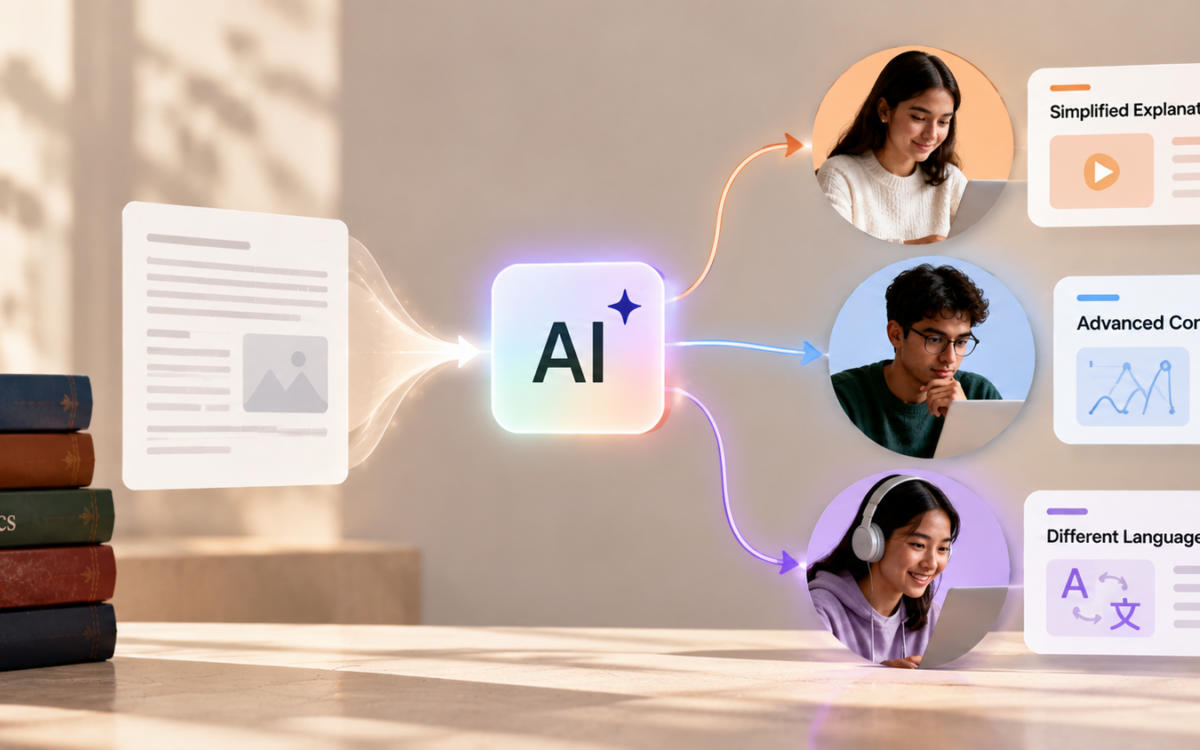
AI-powered authoring is what changes that equation for publishers trying to create digital learning content at scale, by removing the parts of production that used to eat the most hours.
Building AI-Powered Digital Learning Content at Scale
1. Templates speed up how publishers create digital learning content
Most of that 50-to-700-hour range goes to decisions that get made once and then repeated dozens of times: how a quiz screen looks, how a video embeds, how navigation behaves between sections. A template library that already answers those questions lets a production team spend its hours on the content itself instead of rebuilding the same screen layout for the fortieth chapter in a row. We built our own library around exactly this problem, pre-built IP and reusable components that a publisher’s team drops content into rather than designs from zero, which is a large part of why we can keep delivery timelines short without cutting corners on the finished product.
2. AI review catches errors before a course ever gets tested
A publisher producing ten courses instead of two runs into a new problem: ten times the content that needs checking for consistency, tone, and factual accuracy before it goes anywhere near a student. That review used to happen entirely by hand, chapter by chapter, after the fact. Built into the authoring process instead of after it, AI-assisted review can flag inconsistent terminology, tone drift between sections, or a fact that contradicts something stated three chapters earlier, the kind of catch that’s easy for a human editor to miss on the fifth course of the week but obvious to a system checking every course the same way.
3. Design personalization into the content from the beginning
An AI system that adapts content to an individual learner’s pace or level only works if the underlying content was structured to support that from the start, branching points, difficulty tiers, alternate explanations for the same concept. Retrofitting personalization onto content built as one fixed path rarely works well. Publishers creating digital-first content have an advantage here that print-first publishers converting old material don’t: they can design the branching logic into the authoring process itself, so an AI layer has actual structure to work with rather than a flat page to guess at.
4. Question generation works better as part of authoring than as a separate step
A question bank built after a course is finished tends to test what was easy to write a question about, not necessarily what mattered most in the lesson. When a system can read the actual content as it’s written and suggest matching questions in the same pass, the assessment stays tied to what was genuinely taught, section by section, instead of drifting toward generic recall questions added on at the end by whoever had time left in the schedule.
5. The real choice in building AI-powered digital learning content
The real choice a publisher faces is between two production models. One treats every course as a bespoke build, expensive and slow by design. The other works inside a system where templates, review, personalization logic and assessment generation already exist, and content creation means filling that system with subject matter rather than building each piece from zero.
That difference compounds. A publisher who can produce ten interactive courses in the time a competitor produces two isn’t just faster, they’re building a different kind of catalog, one where digital-first content is the default output of every new title rather than a special project reserved for the flagship few. Given where development costs have been heading, that’s the gap that will separate publishers who treat AI-powered digital learning content as core infrastructure from those still treating it as an experiment.
Case study: How Wiley took large-scale learning digital with Liqvid
Wiley is one of the world’s established education and research publishers, with a long history of developing learning and professional content. When Wiley needed to take its classroom-based English training into a digital workforce-learning experience, it partnered with Liqvid.
The resulting programme brought together 120 hours of instructor-led training and 300 hours of self-study, supported by 10,000+ interactive learning elements and delivered across web, Android and iOS. The complete programme was developed in 10 months.
What makes the project particularly relevant for publishers is its scale. Liqvid had to transform a substantial body of structured learning material into a digital experience that could support both guided instruction and independent study across multiple platforms.
For publishers with extensive content libraries, Wiley’s experience demonstrates what becomes possible when content development, interactive authoring and digital delivery are handled through an established technology partner. Instead of treating every digital title as a separate technology project, publishers can build on an existing production framework and focus their effort on the quality and expertise within their content.
Wiley’s project is a practical example of how an established publisher can take substantial volumes of educational content and turn them into a finished, multi-platform digital learning product with Liqvid.