
eBook vs Interactive eBook: What’s the Difference?

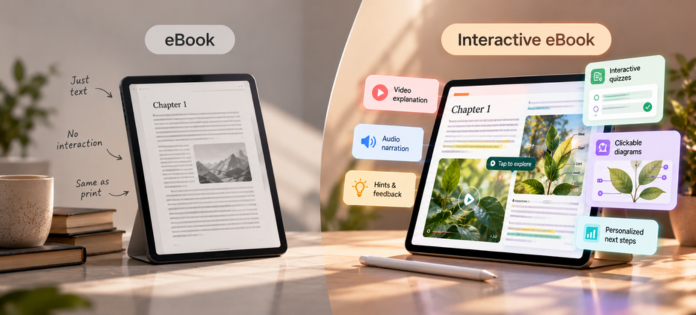
Most people use “eBook” to mean anything readable on a screen, a PDF, a scanned textbook, an app. That’s where the confusion starts. There are actually two very different things hiding under that one word, and the difference between them changes what a student actually gets out of reading.
A 2025 study put a number on that difference. Researchers compared students using interactive e-books against students taught through standard lecturer-led material, and the interactive group came out ahead on every measure that counted, academic performance, engagement, and satisfaction (Chen & Tsai, 2025). Students using them described feeling more interested, paying closer attention, and staying more engaged in class than the comparison group did (Chen & Tsai, 2025). The study wasn’t comparing print against digital. It was comparing two kinds of digital, and only one of them actually behaved differently once the content moved to a screen.
That’s what this piece sorts out, plainly: what actually separates a basic digital book from one built to respond to the person reading it, and why that distinction is the one publishers should actually be making.
What actually separates an eBook from an interactive eBook
1. An eBook is a container. An interactive eBook is a response.
A standard eBook, whether it’s a PDF, an EPUB, or a scanned page turned into a flipbook, carries the same content a printed book would, arranged the same way, read in the same direction. The format changes. The experience of reading it generally doesn’t. A student turns a page, reads the text, and moves on, the same motion repeated from the first chapter to the last.
An interactive eBook changes what happens at each of those pages. We’ve watched students tap diagrams expecting nothing, the way you’d absently poke at a photograph, and then actually sit up when it moved. A question appears mid-chapter instead of waiting for a review section at the end. Audio plays a passage aloud instead of leaving pronunciation to guesswork. The content hasn’t just moved onto a screen, it’s gained behavior.
2. What happens when a student gets something wrong
This is where the split is clearest. A standard eBook does nothing, the wrong answer sits on the page exactly as written, waiting for a teacher to notice it later, if they ever do. An interactive eBook can flag it immediately, offer a hint, or route the student toward a simpler version of the same concept before they move forward.
That gap compounds over a term. A student who stays quietly wrong about something for three weeks because nobody caught it isn’t a rare case, it’s the default outcome of a format with no mechanism for catching it at all. Our Interactive E-book handles this through live tests teachers can generate directly from any chapter, so a gap gets caught the same week it opens, not the same term.
3. Where the test actually lives
In a standard eBook, a test is usually a separate document entirely, printed or linked, disconnected from the chapter it’s meant to check. Somebody has to remember to assign it, hand it out, collect it.
An interactive eBook can skip that handoff. The test lives inside the chapter itself, generated directly from what the student just read, so the two never drift apart and nothing depends on a teacher remembering a separate step. This is one of the customisable templates built into our platform, usable across subjects and languages without a separate setup each time.
4. How multimedia gets treated differently
A standard eBook can embed a video or an audio clip, technically. It usually sits as a static link the reader either clicks or scrolls past without a second thought, which is most of the time.
In an interactive eBook, audio narration, animation, and video are built into the reading flow itself, not bolted onto the margin as an afterthought. The difference isn’t whether the media exists. It’s whether a reader is actually likely to use it.
5. The real cost for publishers in the eBook vs interactive eBook choice
Converting a textbook into a standard eBook is mostly a formatting exercise, strip the page layout, preserve the text, output a file a device can open. It’s fast, and it’s the reason so many “digital editions” exist that nobody actually finishes reading.
Building an interactive eBook is a content decision, not a formatting one. It means deciding what should happen at each point in a chapter where a student might get stuck, bored, or confused, and building a response into that exact spot. That’s slower and harder work, but it’s also the version of the two that the 2025 study’s own finding points toward, engagement and performance both improving once the digital format actually did something, rather than simply existing (Chen & Tsai, 2025).
6. What an interactive eBook looks like in practice
Our Interactive E-book takes an existing PDF or ePub and builds that second kind of response into it, embedded media, activities, assessments generated directly from the chapter, all without requiring a publisher to rebuild the book from scratch. The underlying content stays the same. What changes is whether a student reading it gets a page that waits for them to finish, or one that notices whether they actually did.
That’s the real answer to the eBook vs interactive eBook question. An eBook asks a student to read. An interactive eBook checks whether they understood, and responds to the answer.