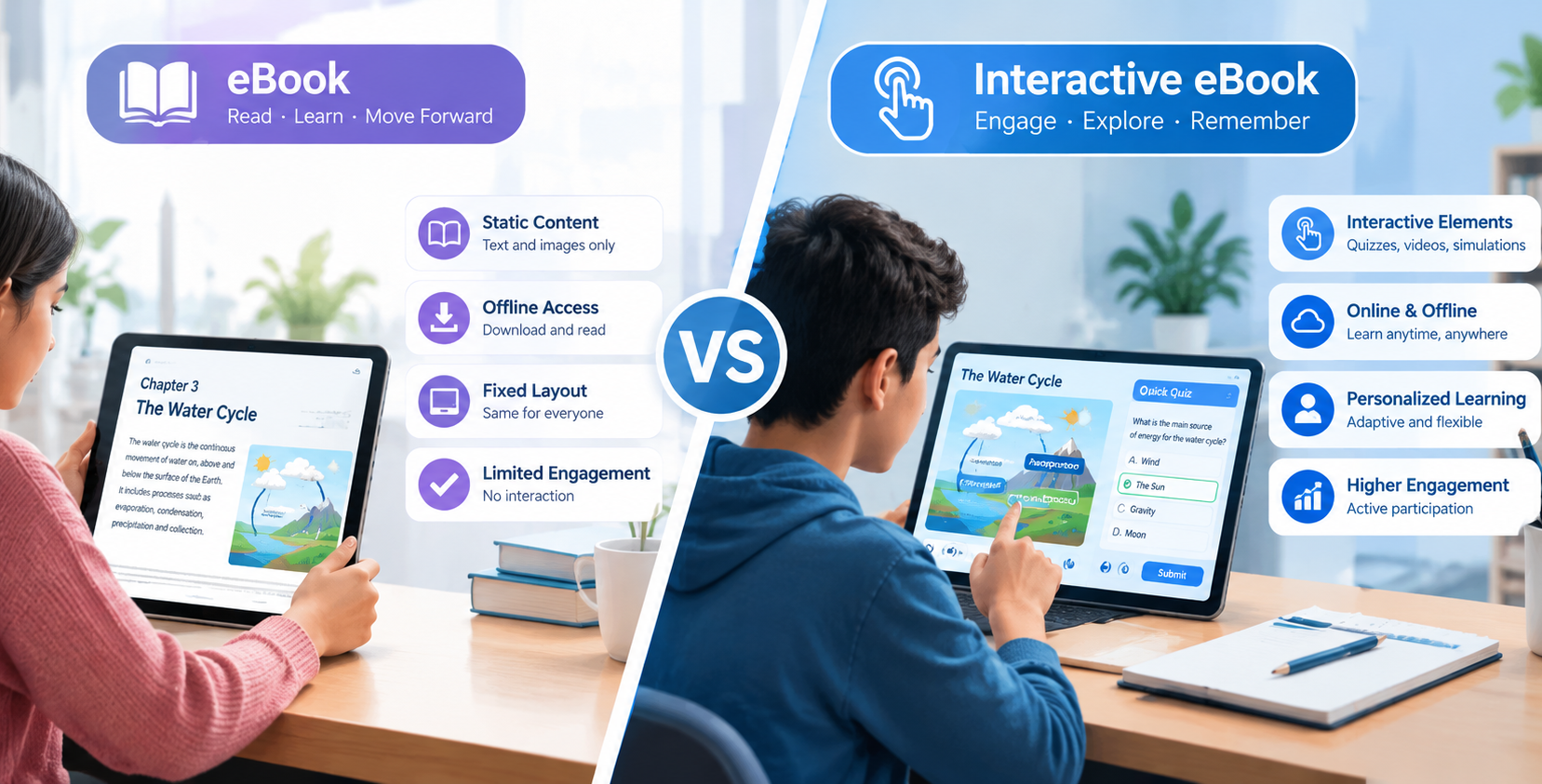
“eBook” covers two very different things: a screen-readable file such as a PDF, and a book that responds to the reader. A 2025 study by Chen and Tsai found students using interactive e-books outperformed peers in lecturer-led courses on academic performance, engagement and satisfaction.
What actually separates the two
1. A container vs a response
A standard eBook carries printed content in digital form. An interactive eBook adds behaviour: tappable diagrams, mid-chapter questions and audio narration.
2. What happens when a student gets something wrong
In a standard eBook the error goes uncorrected. An interactive eBook can flag the mistake, offer a hint or point to simpler material.
3. Where the test lives
Standard tests are separate documents. Interactive eBooks can embed tests generated from the chapter itself.
4. How multimedia is treated
A standard eBook links to media as an extra. An interactive eBook builds audio, animation and video into the reading flow.
5. The real cost for publishers
Standard conversion is mainly formatting. An interactive eBook needs content decisions about where students are likely to struggle.
6. What it looks like in practice
Liqvid’s Interactive E-book converts existing PDFs or ePubs without rebuilding the book.
An eBook asks a student to read. An interactive eBook checks whether they understood, and responds to the answer.
For a detailed discussion, write to info@liqvid.com or call +91-8448360148.