
How Educational Publishers Can Use AI for Content Personalization

Every educational publisher adding AI to their platform eventually runs into the same question from a skeptical product lead or a cautious board: does personalization actually work, or is it a feature line on a pitch deck? Fair question. The honest answer is it depends entirely on how it’s built, and most of the pitch decks skip that part.
A scoping review in Computers and Education: Artificial Intelligence looked across dozens of studies on personalized adaptive learning in higher education. Academic performance improved in 59 percent of the studies reviewed. Student engagement improved in 36 percent (ScienceDirect, 2024). Worth sitting with that gap for a second, personalization doesn’t automatically work. It works when there’s something real underneath it to personalize against. AI content personalization in education gets talked about as a feature you switch on. It’s actually a pipeline, learner data in one end, a tailored experience out the other.
Where AI content personalization in education actually starts
1. You need data before you need an algorithm
This sounds obvious written down. It’s the part almost everyone skips anyway. An AI system adapting to a learner’s pace or weak spots can only do that if something’s genuinely watching the learner work, quiz scores, time per section, what gets retried, what gets skipped entirely. Skip the watching, and “personalized” content is just content with empty variables nobody’s filling in.
We built our Analytics platform around exactly this gap. It tracks classroom and self-practice sessions and spits out dashboards that read differently depending on who’s looking, a learner sees their own progress, a trainer sees a class, an administrator sees everything at once.
2. What learner signal looks like in AI content personalization
A student rewatching the same video three times is telling you something. So is one who breezes through vocabulary but stalls every time a speaking exercise comes up. Most platforms are generating this kind of signal constantly. Most publishers aren’t looking closely enough to catch it.
I’ve seen this play out the dumb way too, a platform tracking everything and doing nothing with it, dashboards nobody checks, data sitting there like a locked room. Our recommendation engine tries not to be that. It even picks up on regional patterns, learners from one part of the country finding a specific set of words harder than learners elsewhere, and weights recommendations around that instead of treating every learner like a blank slate.
What AI content personalization in education looks like in practice
1. When the lesson itself has to change
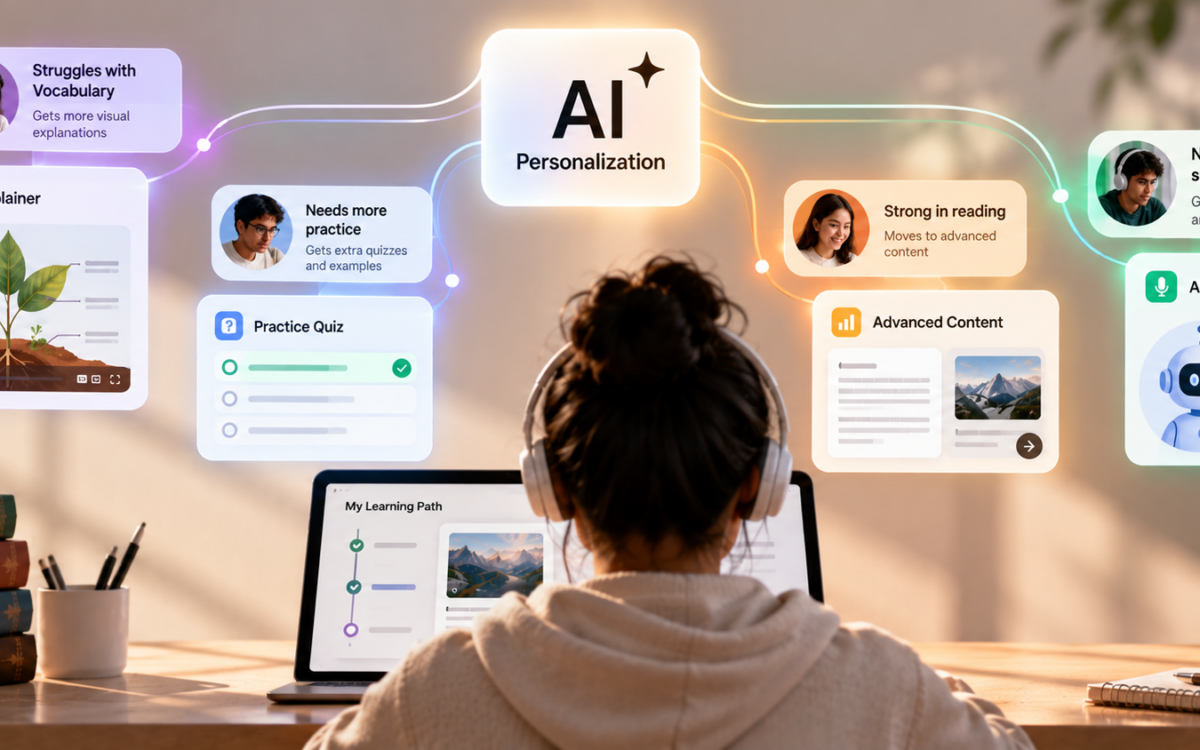
Real personalization isn’t a “recommended for you” banner sitting on top of identical content underneath. It’s the actual lesson shifting. A learner strong in reading moves faster through text and gets more support on speaking. A learner stuck on one word category sees that category keep resurfacing until it sticks.
Our Role Play component works this way end to end, watch, enact, review, and the AI analysis that comes out of that feeds directly into what the student sees next. It is a next step, built off what actually happened in that attempt.
2. Why scale changes the math for AI content personalization
One teacher adjusting for thirty students by feel, that’s manageable, teachers have always done some version of this. A publisher’s content reaching a million learners across thousands of locations is an entirely different problem, and nobody’s solving it by reviewing dashboards one learner at a time.
That’s roughly the scale our own programs sit at, over a million learners, 5,000 locations, past 1.5 million hours of instruction logged. At that size personalization stops being a nice-to-have feature. It’s the only way the same piece of content doesn’t flatten into one generic average that fits almost nobody well.
How to tell real AI content personalization in education from fake
Here’s a cheap way to check whether something’s actually personalized or just dressed up to look that way: watch what changes for two different learners hitting the same material. If the only difference is a name in a header, that’s not personalization. That’s a template with a variable swapped in.
If the sequence changes, the difficulty changes, the pacing changes, all built off what the platform actually watched that learner do, that’s the real version. And it’s the one the research keeps pointing back to as the one that moves outcomes, not the banner, the underlying behavior behind it.
One honest caveat before wrapping this up: even good personalization data goes stale. A learner’s needs in week one aren’t their needs in week eight. The systems worth trusting are the ones that keep re-checking the data rather than locking in a profile early and running with it.
Case Study: How Wiley Turned Classroom Training into Digital Learning
A practical example of this transformation comes from Wiley, which worked with Liqvid to convert classroom-based English training into a digital learning experience for workforce development.
The project brought together 120 hours of instructor-led training, 300 hours of self-study content and more than 10,000 interactive learning elements across web, Android and iOS. The project was completed in 10 months, giving learners access to a structured digital learning environment beyond the traditional classroom.
The case highlights how educational publishers can build richer digital learning experiences by bringing together structured content, interactive activities, assessments and learner analytics. Liqvid’s current platform also supports personalized learning paths, AI-powered speaking practice, writing analysis and real-time progress tracking.
For publishers exploring AI-powered personalization, these capabilities can work together to make learner activity part of the learning journey. Data from practice, assessments and interactions can help platforms understand learner needs and support more relevant learning experiences over time.
The goal is to build a learning experience that can understand learner behaviour, respond to individual needs and support learning at scale.