
How Does a Language Lab Work?

A language lab runs on one loop: a student hears or sees a piece of language, practises it, produces a response, and gets feedback on that response. The loop repeats until the skill sticks. That has been the model since 1911, when a phonetics lab at Washington State College first let students record their pronunciation and compare it against a native speaker’s.
What has changed since then is speed. In an early lab, a student waited for a teacher to listen to a tape and mark it up. In a modern lab, a student records a sentence and gets pronunciation and fluency feedback in seconds, then tries again in the same sitting. Three or four attempts in one session teach more than one attempt reviewed a week later.
Inside a Session
A session opens with a short input: a dialogue, a grammar point, a task the teacher sets up in two or three sentences. From there the students do the work.
A typical exercise on everyday conversation might run like this. Students listen to a short exchange between two speakers. They pick out three or four phrases worth reusing. They repeat those phrases aloud, matching stress and rhythm to the recording. Then they build a short exchange of their own using the same phrases, either with a partner or by recording themselves. Each stage asks the student to do something with the language rather than just take it in.
The Technology Behind the Loop
Older labs ran on headsets, tape decks, and a teacher walking the room with a set of controls. The mechanics were simple: play a model, record a response, play both back side by side.
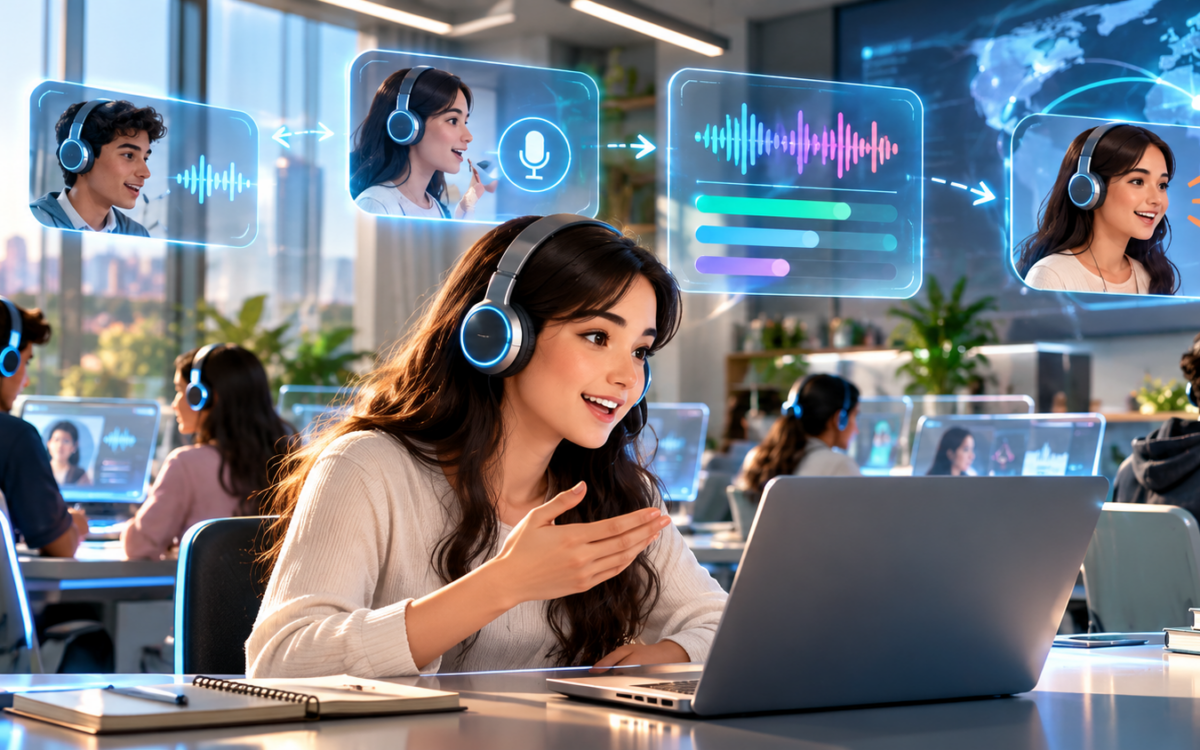
A modern language lab keeps that same structure and adds two things: automated analysis and scale. A student speaks into a microphone, and speech-recognition software scores the response on pronunciation, fluency, and accuracy without a teacher needing to sit through the recording first. That frees the teacher to spend class time on the responses that actually need a human ear.
Role-play exercises use the same technology for a harder task. A student hears a short scenario, for example a customer complaint or a job interview opener, and has to respond in character rather than repeat a scripted line. The system scores the response the same way it scores a repetition drill, which means students get feedback on language they generated themselves, not just language they copied.
Practice, Feedback, and What Happens After Class
Classroom time covers the input and the first round of practice. Everything after that runs on the student’s own schedule. A well-built programme pairs instructor-led sessions with self-paced practice and a structured coursebook, so a student who wants more repetition on a specific weak point does not have to wait for the next class to get it.
Feedback shows up at two points: right after an exercise, when the student sees a score and can hear their own recording next to the model, and later, when a teacher or administrator reviews progress across a group of students. Both matter. Immediate feedback tells the student what to fix. Aggregate progress data tells the teacher where the whole class is stuck.
The Shape of the Process
Strip away the tools and the process is old and simple: a student learns something, practises it, produces it, gets told how it went, and practises it again with that feedback in mind. Technology has not changed that shape. It has changed how fast a student moves through it and how much of that movement can happen without a teacher in the room for every step.
That is the real value of a modern language lab. Not that it replaces classroom teaching, but that it turns the hours between classes into productive practice time instead of dead time.
Evidence From the Classroom
A study published in Nature’s Humanities and Social Sciences Communications tracked undergraduate EFL students who used an AI-powered speaking app for after-class assignments, alongside a control group following standard coursework. The experimental group showed significantly stronger gains in overall speaking performance, with the clearest improvements in pronunciation and fluency. The result lines up with the loop a language lab is built around: students who got automated feedback outside class hours, on top of regular instruction, improved faster than students relying on classroom practice alone.