
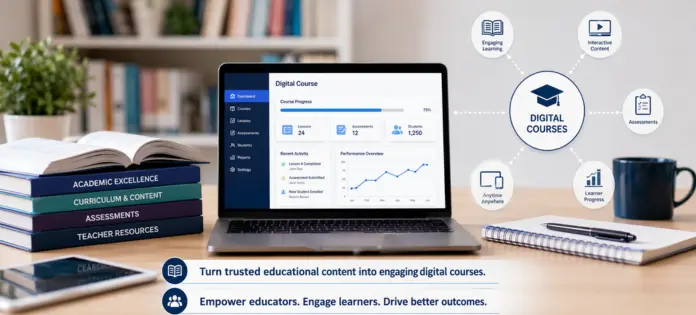
How Publishers Can Successfully Sell Digital Courses

Publishers looking to sell digital courses for themselves already have one major advantage: trusted educational content. For decades, educational publishers have built their reputation on trust. Every textbook, workbook, assessment, and teacher resource reflects years of editorial expertise, curriculum alignment, classroom experience, and collaboration with subject matter experts. That trust has become one of a publisher’s greatest business assets, shaping long-term relationships with schools, educators, and learners.
As education continues to evolve, institutions are looking beyond printed resources. They want digital learning experiences that support classroom teaching, enable independent learning, and provide measurable learner progress. This creates an opportunity for publishers to extend the value of content they already own by offering digital courses alongside their traditional publishing portfolio.
Successfully selling digital courses depends on creating learning experiences that institutions can confidently adopt. Structured learning, meaningful assessments, learner engagement, and measurable progress all influence purchasing decisions. Publishers who understand these expectations are better positioned to build digital offerings that create lasting value for educators, learners, and institutions.
Your Greatest Competitive Advantage Already Exists
1. Years of Educational Expertise Build Trust
Educational publishers already possess something few organizations can replicate: credibility. Years of working with educators, reviewing curriculum requirements, refining learning materials, and incorporating classroom feedback have created resources that institutions already recognize and trust.
When schools evaluate digital courses, they evaluate that same credibility. Decision-makers want confidence that the learning experience is built on academically reliable content capable of delivering meaningful educational outcomes. Publishers who build digital courses on this foundation carry their existing reputation into digital learning.
2. Organize Content Around Learning Outcomes
High-quality educational content becomes more valuable when it is organized around clear learning outcomes. Rather than simply presenting chapters digitally, publishers can structure content into learning paths supported by practice activities, assessments, and measurable milestones.
This makes the learning journey easier for students to follow while helping educators monitor progress more effectively. It also allows publishers to update individual modules as curriculum requirements evolve without redesigning entire courses.
What Makes Institutions Invest in Digital Courses
To sell digital courses for publishers successfully, organizations need more than quality content – they need structured learning experiences, learner engagement, and measurable outcomes.
1. Support Teaching, Not Just Learning
Educational institutions look for digital courses that fit naturally into classroom teaching. Teachers need the flexibility to assign lessons, monitor learner participation, conduct assessments, and guide students throughout the learning journey.
Digital courses that support educators as effectively as learners become easier to integrate into existing academic programs, increasing their long-term value for institutions.
2. Provide Visibility into Learner Progress
Schools increasingly expect digital learning solutions to provide meaningful insights into learner performance. Understanding how students progress through a course, where they require additional support, and how they perform across learning activities helps educators make informed teaching decisions.
These insights also benefit publishers. Learner engagement patterns and assessment results provide valuable feedback for improving future editions, refining instructional design, and continuously strengthening digital learning experiences.
3. Create Learning That Continues Beyond the Classroom
Learning continues well beyond scheduled classroom sessions. Students revisit lessons, prepare for examinations, complete assignments, and reinforce concepts at their own pace.
Digital courses that remain accessible across devices allow institutions to extend learning beyond the classroom while giving students the flexibility to continue learning whenever and wherever they choose. This continuity strengthens learner engagement and increases the overall value of the course.
Transform Trusted Content into Digital Courses That Sell
Publishers that want to sell digital courses for publishers don’t need to start from scratch. Their existing educational content already provides the foundation for creating engaging digital learning experiences.
1. Structure Existing Content for Digital Learning
Most educational publishers already have extensive libraries of textbooks, assessments, teacher resources, and supplementary materials. The opportunity lies in transforming these resources into structured digital courses that institutions can adopt with confidence.
A purpose-built Language Learning LMS helps publishers organize existing content into learning paths, interactive activities, assessments, and learner progress tracking within a single platform. Instead of rebuilding content, publishers can extend its value by delivering engaging digital learning experiences while preserving the academic quality educators already trust.
2. Maintain Your Brand While Expanding Digitally
Brand reputation is built over years of delivering consistent educational quality. Digital courses should strengthen that identity across every learner interaction.
A white-label Language Learning LMS provided by Liqvid enables publishers to deliver digital courses under their own brand, providing schools and institutions with a consistent learning environment while reinforcing publisher recognition throughout the learning journey. Publishers retain ownership of both the learner experience and their brand while expanding into digital learning.
How Leading Publishers Are Expanding Their Digital Business
Across the global publishing industry, digital courses have become an important extension of traditional educational publishing. Rather than treating digital learning as a separate offering, leading publishers are integrating it into their existing portfolios to support schools, educators, and learners throughout the learning journey.
Publishers such as Pearson, Cambridge University Press & Assessment, and Wiley have expanded beyond printed resources by combining trusted educational content with structured digital learning experiences. Their focus has been on improving accessibility, supporting continuous learning, and providing educators with greater visibility into learner progress. These developments reflect a broader shift in educational publishing, where digital courses have become an important part of institutional learning rather than an additional product offering.
For publishers planning their own digital strategy, the objective is rarely creating entirely new content. It is extending the value of proven educational resources through structured digital courses that meet evolving institutional expectations.
Digital Courses Create Long-Term Value for Publishers
Selling a digital course creates an ongoing relationship with institutions rather than a single transaction. Educators continue using course resources, learners engage throughout the academic term, and publishers gain valuable insights into learner progress and content performance. These insights support continuous improvement while helping publishers strengthen future editions and respond more effectively to changing educational needs.
Publishers building successful digital businesses are expanding the value of content they already own. Long-term success depends on delivering digital courses through a platform that supports structured learning, learner progress, assessments, and institutional delivery at scale. With the right digital learning ecosystem in place, publishers can strengthen institutional relationships, improve learner outcomes, and create sustainable digital growth.
Final Thought
Publishers that want to sell digital courses should combine trusted educational content with a scalable learning platform that supports assessments, learner progress, and institutional delivery.
For a detailed discussion about selling your courses, kindly email at info@liqvid.com or Call at +91-8448360148