Websites have long been the publisher’s main digital layer: the place where content is published and found. Digital revenue now accounts for more than 30% of publisher revenue (WAN-IFRA), and learning use cases put pressure on what a standard website can do.
How websites and LMS platforms differ in real publishing use
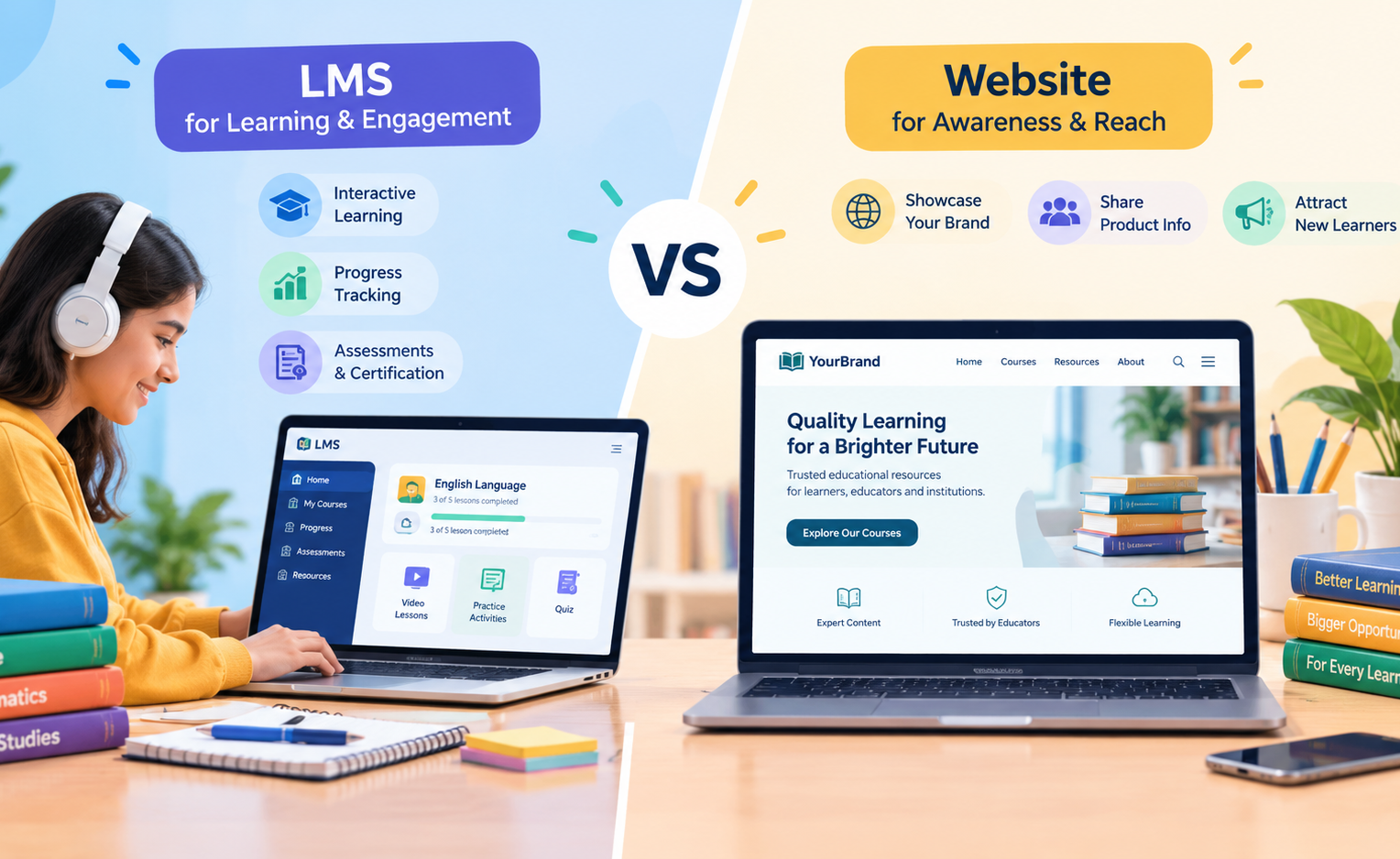
1. Content access vs structured flow
A website lets people browse and revisit freely, which suits discovery and reference. An LMS enforces a sequence, so a compliance course can require the foundation modules before the advanced ones.
2. Passive consumption vs interactive learning
On a website the journey ends at reading, watching or downloading. An LMS adds assessments, checkpoints and progress-based movement, as Pearson’s MePro does.
3. Basic metrics vs user-level tracking
Websites report aggregate signals such as visits and traffic sources. An LMS follows each learner: where they started, where they paused, time per module and completion. Scholastic is an example of a move from traffic data to reading behaviour at student level.
4. Open access vs role-based distribution
Websites are generally open to every visitor. An LMS assigns and sequences content by user, group or role, the way Wiley’s digital ELT programme gives different university clients different content packages.
5. Brand presence vs a learning environment
A website is the brand’s front door. An LMS becomes a place learners return to over time, like Cambridge One.
Making the right choice
A website is for reach. An LMS is for outcomes.
Using one to do the other’s job costs publishers time, data and audience trust. Know what your content is asking users to do, and build accordingly.
For a detailed discussion, write to info@liqvid.com or call +91-8448360148.