We followed 2.1 million practice answers from nearly 30,000 learners. The reason so many people freeze when they speak English was hiding in plain sight.
Liqvid · November 2026 · 6-minute read
She reads English storybooks for fun. She scores full marks on grammar quizzes. Then a visitor asks her, “What did you do at the weekend?”, and the words just won’t come.
If that sounds familiar, you’re not alone. In India and around the world, millions of learners understand English far better than they can speak it.
We wanted to know why. So we looked at what nearly 30,000 school learners actually did on Liqvid’s English platform between 2023 and 2026: every tap, every typed word, every recording. That’s 2.1 million practice answers.
The surprise: speaking almost never happened
Ask learners how they practise English and most will say “every day”. The question is: practise what?
Guess first: Out of every 100 practice answers in our study, how many do you think were spoken out loud? A. 25 · B. 10 · C. 1
Answer: C. Just one.
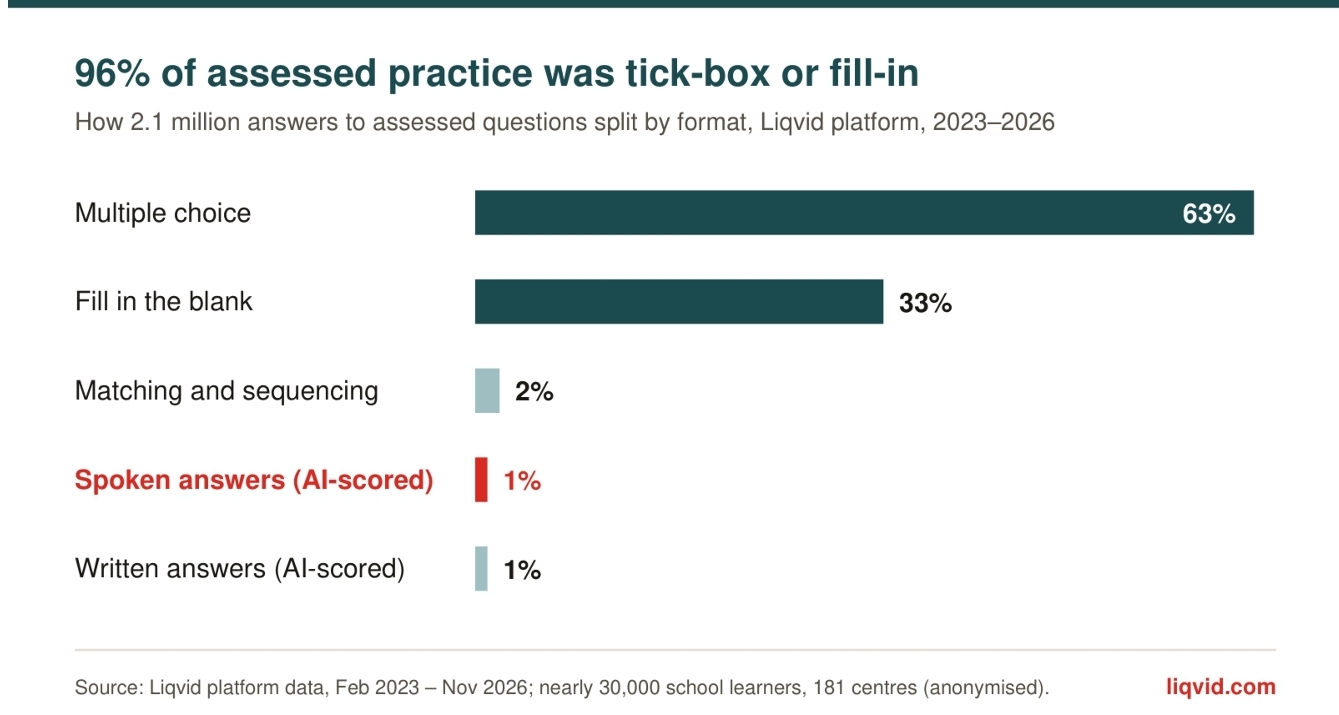
Bar chart: of 2.1 million practice answers, 63% were multiple choice, 33% fill in the blank, 2% matching, 1% spoken and 1% written
Our data: for every 100 answers, 63 were a tap on a multiple-choice option and 33 were a word typed into a blank. Only 1 was spoken.
So learners were practising English every day. They just weren’t practising speaking it.
Why: the quickest option wins
Nobody sets out to avoid speaking. Practice simply drifts towards whatever is quickest and safest.
Our data: a multiple-choice answer took about 8 seconds. A spoken answer took more than a minute. Speaking also feels exposed: you hear your own mistakes, and you imagine others hearing them too.
That matters, because practice is skill-specific: practising comprehension improves comprehension, and practising speaking improves speaking. A learner who answers thousands of questions becomes very good at recognising English. Their speaking stays where it was.
The classroom can’t make up the gap on its own. In a 40-minute lesson with 35 learners, even if a third of the time goes to speaking, each learner gets about 23 seconds.
The turning point: feedback and one more try
Here’s the good news. When learners did speak, and got feedback, something remarkable happened.
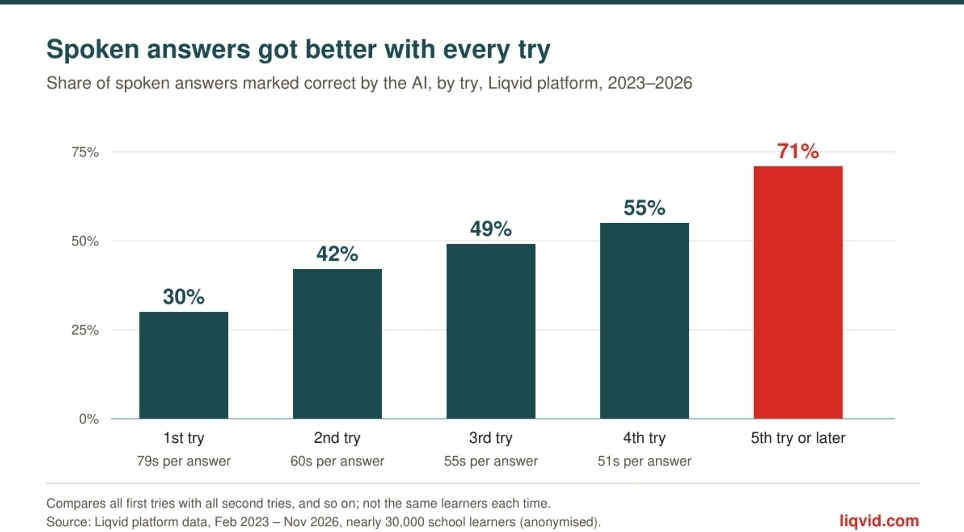
Bar chart: spoken answers marked correct rise from 30% on the first try to 42%, 49%, 55% and 71% by the fifth try, while time per answer falls from 79 to 51 seconds
Our data: on the first try, 30% of spoken answers were marked correct. On the second, 42%. By the fifth, 71%. Learners got quicker as they improved, too: from 79 seconds on the first try to 51 seconds by the fourth. Faster and more accurate at the same time: that’s what growing fluency looks like.
What made the difference? Each spoken answer came back with something specific to fix: a sound, a word, a point of grammar. So every new try built on the last. Research on feedback finds the same: it works best when it says exactly what to change, and the learner then fixes it themselves.
Different learners reached each try, and those who kept going may have been more determined, so this is a strong pattern rather than proof.
The missing piece: role-play
Most digital English courses are built from videos, quizzes and exercises. Few include role-play, yet it is the speaking format the evidence supports most strongly.
What role-play is. Role-play is a form of simulation. Instead of answering questions about a situation, the learner steps into it and carries out a real communicative task in spoken English, then receives feedback on what they said.
Why it works. Role-play brings three of the strongest findings in learning research together in a single activity:
• It is simulation. Simulation-based learning shows some of the largest effects in education research, and role-play is among its most effective forms.
• It requires production. Learners must generate language rather than select it from options. That is the kind of practice that builds durable speaking skill.
• It is authentic. Tasks that resemble situations from a learner’s own life produce better outcomes, and role-play is built from such situations.
Research on AI speaking practice points the same way: dialogue built around a clear communicative goal improves speaking considerably more than open-ended chat.
Why it has been rare. In a classroom, role-play is costly. It needs partners, time and a teacher to listen and correct, so most learners seldom get a turn. It is also socially risky, because speaking in front of peers is where language anxiety peaks. AI removes both barriers: every learner can work through every scenario, privately and as often as needed, with feedback in seconds. What AI cannot supply on its own is the design. A screen-based role-play works only if it builds in what makes live role-play effective, and that is far harder to build than a quiz.
Our data: role-play was one of the most-used activities on our platform. More than 18,000 learners used AI role-plays, about 20 times each on average, and they stayed with them.
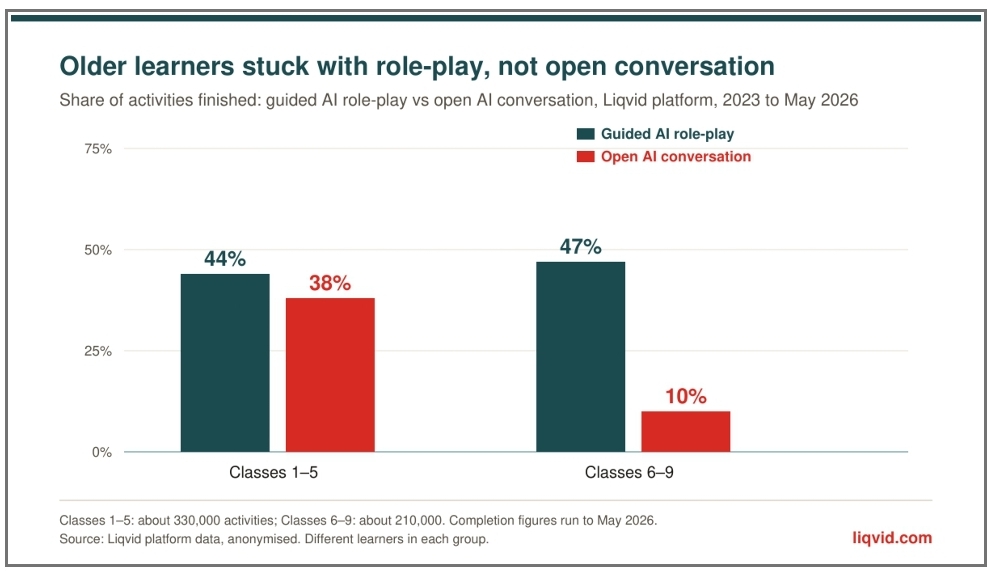
Bar chart: in Classes 1 to 5, learners finished 44% of guided AI role-plays and 38% of open AI conversations; in Classes 6 to 9, 47% of role-plays but only 10% of open conversations
Younger learners, in Classes 1 to 5, finished guided role-plays and open AI conversations at similar rates: 44% and 38%. From Class 6, open conversations, where learners decide everything themselves, dropped to just 1 in 10 finished. Role-plays held steady at 47%.
This is the age at which being observed and evaluated begins to weigh on learners. A model to follow and a defined role sustain speaking where an open prompt does not.
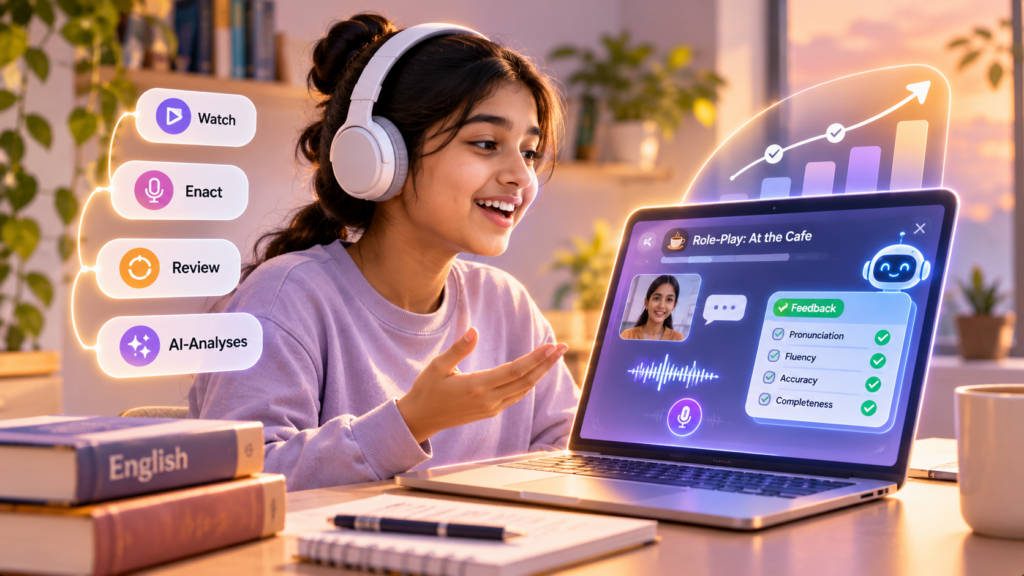
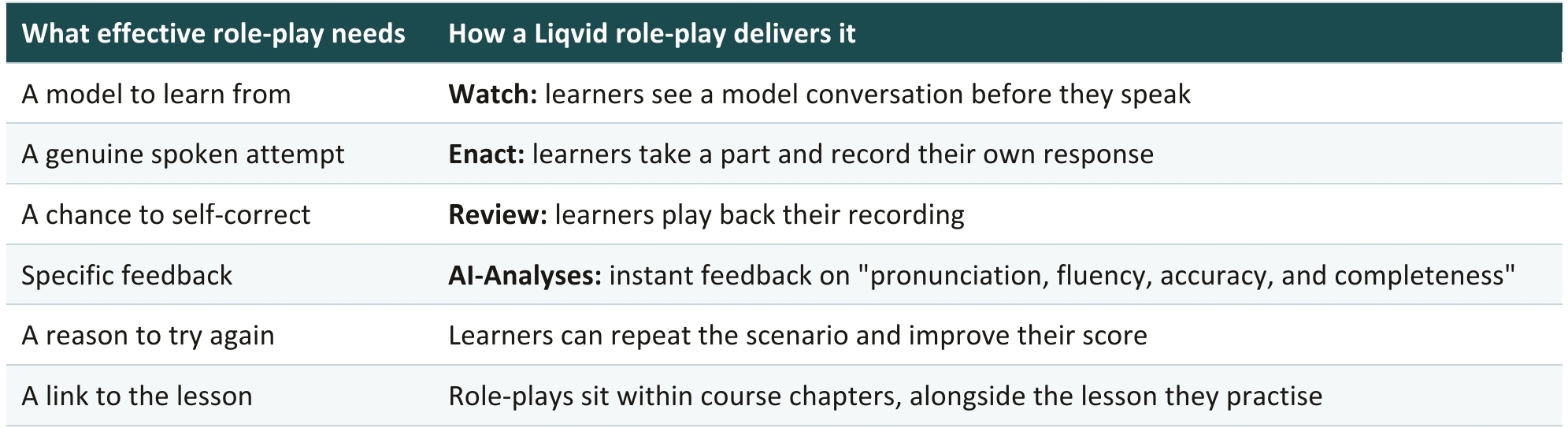
How Liqvid designs role-play. Each Liqvid role-play follows four steps, “Watch, Enact, Review & AI-Analyses”, built around what makes role-play effective:
The bottom line
Learners don’t learn to speak by ticking boxes. They learn by speaking, hearing what to fix and trying again, ideally with a model to follow and no one watching. With the right tools, every learner can now do that as often as they like.
Practise speaking with Liqvid
Self-paced AI speaking practice is part of our English Language Lab. Publishers can add the same practice to their own courses through our Language LMS.
Talk to us · info@liqvid.com