
What Is an Interactive eBook? A Guide for Educational Publishers

A textbook takes considerable work to develop. Authors refine explanations, editors review the content, and illustrators help make complex ideas easier to understand. When that textbook moves to a digital format, publishers have an opportunity to build on this work and give readers more ways to engage with the material.
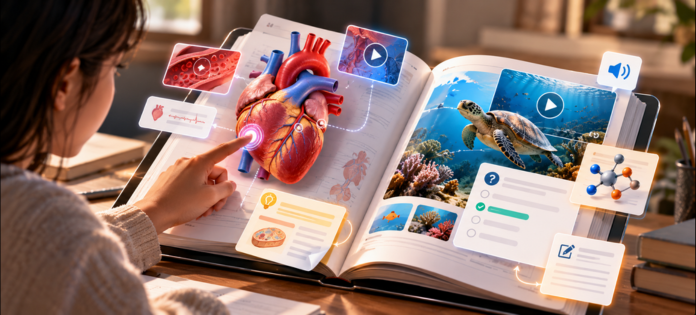
An interactive eBook brings educational content to life through purposeful digital experiences. Students can explore diagrams, listen to passages, attempt activities and check their understanding as they progress through a chapter.
For educational publishers, the opportunity lies in deciding how these interactions can support the subject, the learner and the original teaching objectives.
How Interactive eBooks Improve Digital Learning for Students
Reading is an important part of learning, but some concepts become easier to understand when students can explore them. Consider a science textbook chapter about the human heart. The printed edition might contain a labelled diagram, an explanation of blood circulation and questions at the end. An interactive version could let students explore the parts of the heart, follow the movement of blood through an animation and answer questions that test their understanding.
Each element serves a purpose within the lesson. Students can revisit the explanation, explore the visual material and practise applying what they’ve learned. The same approach works differently across subjects. A mathematics chapter might use step-by-step problem solving, while a language-learning title could include spoken dialogues and response exercises. The interaction should fit the subject and help students work through the material.
Designing Interactive eBook Content Around Learning Objectives
Creating an interactive eBook starts with understanding what a chapter is meant to teach.
A publisher developing a language-learning book, for example, might want students to understand a conversation, recognise new vocabulary and use the expressions in everyday situations. Listening activities can help with comprehension, while guided practice gives learners an opportunity to apply the vocabulary.
The important decisions happen during content planning. Which concepts need a visual explanation? Where would practice help? Which topics require feedback so students can understand their mistakes?
These questions help publishing teams choose suitable interactions for each chapter. They also keep the original educational purpose at the centre of the digital experience.
A well-planned interactive eBook follows the logic of the lesson, with each activity contributing to the learner’s progress.
Converting Existing Textbooks into Interactive eBooks
Educational publishers often have extensive catalogues of textbooks, workbooks and supplementary learning material. Much of this content has already been reviewed, tested and aligned with a curriculum.
Converting existing material into interactive eBooks gives publishers a way to extend the usefulness of these resources. PDF and ePub files can serve as starting points for developing richer digital publications, depending on the content and the intended experience.
The process involves reviewing the source material, identifying opportunities for interaction, adapting the content and testing the finished publication across supported devices.
For instance, a publisher could begin with one chapter of an existing textbook. The team might add an interactive diagram, a short practice activity and a chapter assessment. Feedback from teachers and students can then inform the approach before it is applied to the rest of the book.
Starting with a focused chapter also helps publishers understand the time, resources and editorial decisions involved in developing interactive content at scale.
Using Interactive eBooks in Digital Learning Platforms
Interactive eBooks can serve different purposes depending on how a publisher plans to distribute and use them.
Some publications are designed primarily for independent reading. Others form part of a broader digital learning programme that includes lessons, practice activities, assessments and progress tracking.
This distinction influences how the content should be structured. A standalone digital textbook needs clear navigation and an accessible reading experience. A publication intended for a structured course may also need to connect with learning activities and assessment workflows.
Educational content platforms can support these different requirements through tools for creating interactive publications, developing digital courses and incorporating assessments. Publishers can choose an approach based on their catalogue, audience and long-term digital strategy.
The wider EPUB ecosystem also provides a technical foundation for digital publishing. The W3C’s EPUB 3.3 specification supports structured publications built with web technologies, including HTML, CSS and SVG. Publishers developing interactive content should also consider accessibility, navigation and compatibility throughout the production process.
Best Practices for Creating Interactive eBooks for Education
A successful interactive eBook requires thoughtful planning throughout development. Publishers should pay attention to a few practical considerations:
• Keep the learning objective clear: Every interaction should support a concept, skill or learning outcome.
• Preserve content accuracy: Explanations, diagrams, answer keys and feedback must remain consistent with the approved educational material.
• Make navigation simple: Readers should be able to move between sections and activities without losing their place.
• Consider accessibility: Text, controls, media and navigation should be designed for learners with different needs.
• Test with real users: Teachers and students can reveal usability issues that may not appear during internal reviews.
• Plan for scale: Reusable templates and a consistent production workflow can help teams develop multiple titles efficiently.
Building Better Digital Learning Experiences from Existing Content
These principles give publishers a practical foundation for developing interactive editions while maintaining editorial quality.
Interactive eBooks give educational publishers more ways to use the content they’ve already developed. Their value depends on how well the digital experience supports the lesson, encourages practice and helps students understand the material.
A useful first step is to select one title or chapter and identify where learners could benefit from additional participation. From there, publishers can develop a focused prototype, gather feedback and refine the approach before expanding it across their catalogue.
With the right content strategy and publishing technology, existing educational material can become the foundation for engaging, accessible and adaptable digital learning experiences.