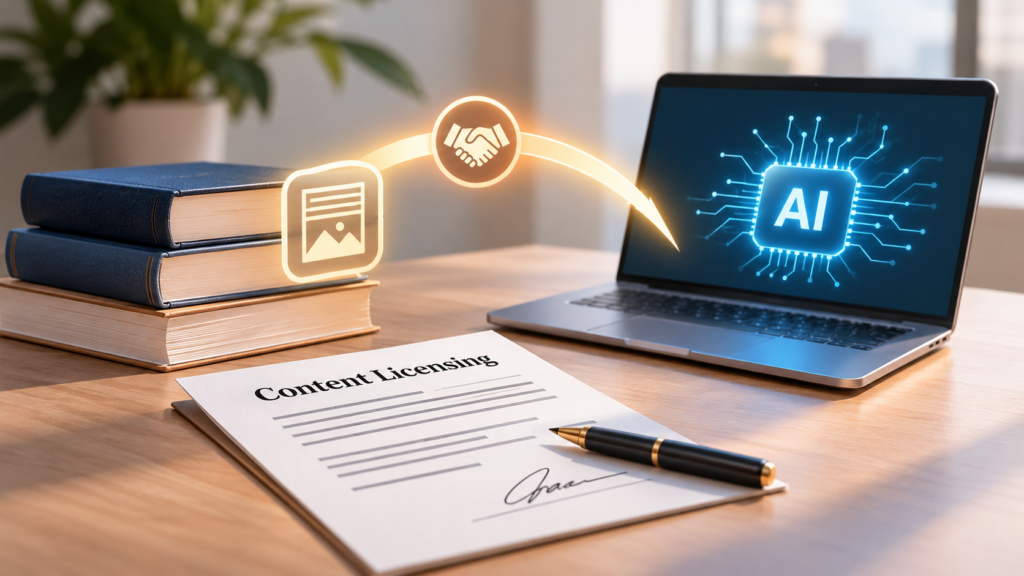
In plain English, AI content licensing is a deal. A publisher gives an AI company permission to use its content, and the AI company pays for it. The publisher is the licensor. The AI developer, such as OpenAI, Google, Microsoft or Mistral, is the licensee.
The jargon is what makes it confusing. These are the words you will hear most often:
| Term | What it means |
| License | Permission to use content on agreed terms, for an agreed price |
| AI training license | A license that lets an AI developer use your text to build or improve a model |
| Opt-out | A rightsholder saying “do not use my content for AI training”. In the EU it must be machine-readable |
| Fair use | A US legal defence that allows some uses without permission. Courts are still deciding how it applies to AI training |
| Attribution problem | The difficulty of knowing how much one publisher’s content improved an AI model |
Why AI content licensing exists: from unlicensed use to a negotiated market
The first generation of large language models learned from text gathered with little or no permission. Three pressures ended that arrangement.
Courts. By early 2026, copyright owners had filed more than seventy infringement suits against AI companies in the United States alone, according to the Copyright Alliance. Outcomes so far have been mixed, so no developer can assume that unlicensed training is safe.
Regulators. The European Union now requires providers of general-purpose AI models to publish a summary of their training data and to respect rightsholders who opt out. The core duties took effect on 2 August 2025.
Commercial logic. Once the legal risk was real, a licence became a way to buy certainty. AI developers get clear permission and a steady supply of quality content. Deals now range from large upfront training licences to narrower inference-only arrangements.
AI content licensing timeline: how the market formed
| When | What happened |
| Dec 2025 | India’s DPIIT publishes a working paper on AI and copyright, adding to the global policy debate |
| Sep 2025 | Microsoft launches the Publisher Content Marketplace |
| Jul 2025 | Cloudflare releases tools to let sites block or charge AI crawlers, and the EU publishes its General-Purpose AI Code of Practice |
| Jun 2025 | A US judge rules in Bartz v. Anthropic. The case later settles for at least USD 1.5 billion |
| 2024 | News Corp signs a reported multi-year deal with OpenAI |
| 2023 | The New York Times sues OpenAI and Microsoft |
Read from the bottom up, the table shows the shift. First came the lawsuits. Then came the first big deals, a landmark settlement, and finally platforms built to license content at scale. The White Paper describes this as a move from taking content without permission to structured, and still hotly debated, dealmaking. Publishers can no longer assume their work is free to take, and AI companies can no longer assume that taking it is safe.
Want the full picture? Download the full AI Content Licensing report for market sizing, a comparison of licensing models and a country-by-country legal view.
Types of AI content licensing models: five common set-ups
A negotiated market does not mean one standard contract. Five structures now exist side by side, and the best fit depends mostly on the size of the publisher:
| Structure | How it works | Example |
| Direct, voluntary | One publisher and one AI company negotiate a bespoke deal | News Corp and OpenAI |
| Collective | A body licenses many publishers’ content under shared terms | Rights bodies and publisher alliances |
| Revenue share | The publisher receives a share of what the AI product earns | Prorata’s 50% royalty model, with 500+ publishers |
| Marketplace | Publishers list content on a platform that AI developers buy from | Microsoft’s Publisher Content Marketplace, September 2025 |
| Value in kind | Payment comes as non-cash benefits, such as analytics or visibility | Partnerships that trade access for traffic and data |
No structure has won yet. The White Paper expects a tiered future, with direct deals for the largest archives and collectives or marketplaces for everyone else. Deal values are press-reported estimates, because most terms are confidential. Pricing is also hard because of the attribution problem: it is difficult to show how much one publisher’s content improved a model. Our full comparison of the five AI content licensing models goes through each in detail.
Liqvid helps book publishers take part in this market. We license existing catalogues to AI companies for model training, and publishers keep ownership of their content. Getting started means sharing a title list, with no obligation. See how Liqvid’s AI licensing for publishers works.
Frequently asked questions
Is AI content licensing the same as copyright?
No. Copyright is the legal right that protects your work. A license is a contract in which you use that right to give someone permission, on agreed terms and for a fee. Licensing does not transfer ownership of your content.
What is an AI training license?
It is permission for an AI developer to use your text to train a model, in return for payment. It is the most common type of AI content license. Some deals also cover inference, meaning use of your text in live answers, and price it separately.
Why are AI companies now paying for content they once used for free?
Because the legal risk became real. Since 2023, copyright owners have filed dozens of lawsuits, and in the EU developers must now respect opt-outs and publish summaries of their training data. A license gives clear permission and a dependable supply of quality content, which is often worth more than the uncertainty it removes.
Is there one standard AI content license?
No. Direct, collective, revenue-share, marketplace and value-in-kind structures all exist. Large publishers usually negotiate directly, while smaller ones tend to use collectives or marketplaces. Terms vary widely and most are confidential, so compare scope, term and reporting carefully.
Next steps
AI content licensing is still being invented, and publishers who understand it early are in the strongest position to shape the terms. Download the full AI Content Licensing report to see the market sizing, the five licensing models and the legal picture in the US, EU, UK and India.