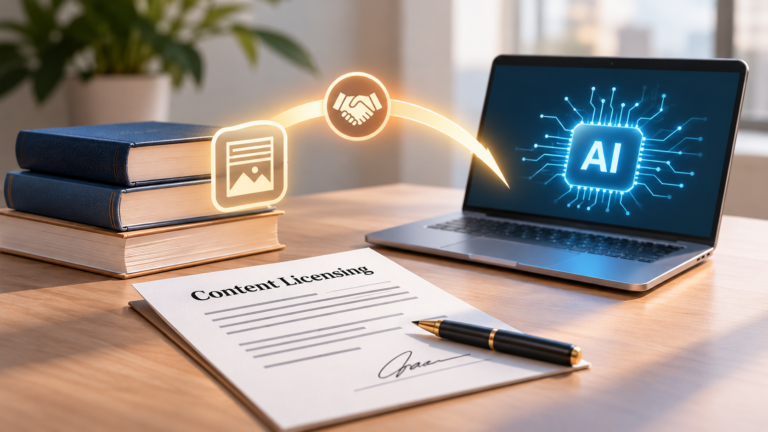
A.I. content licensing is a permission to use copyrighted material in an A.I. system in exchange for payment. The content owner, usually a publisher, grants it. The AI developer, such as OpenAI, Google, Microsoft or Mistral, receives it.
That is the whole idea behind the AI licensing meaning most people search for. The detail is in what the permission covers. Two uses matter most:
• Training. The text is used to teach a large language model how language, facts and reasoning fit together. A deal for this is often called an AI training licence.
• Inference. The AI system draws on the text while answering a user’s question, for example by summarising a news article and linking to it. This is the use that can send readers away from a publisher’s own site.
Why do developers pay for text they could scrape for free? Because quality is scarce. Clean, fact-checked and professionally edited writing is worth far more to a model than the larger, messier open web. Reported journalism, peer-reviewed research, textbooks and fiction are exactly that kind of material.
A useful way to think about it: licensing is syndication for a new kind of reader, one that is a machine.
Why publishers are licensing now
Three forces are pushing publishers to the table.
Money. The Paper MediaAndTheMachine (2025) cites 35 disclosed deals and estimated that AI companies spent about USD 816.7 million on content licences in 2024. Grand View Research projects the market for AI datasets and licensing in academic research and publishing will grow from about USD 381.8 million in 2024 to USD 1.59 billion by 2030, a compound annual growth rate of 26.8% (Treat these figures as estimates. Deal terms are mostly confidential, so the real total is probably higher).
Traffic. AI answers can satisfy a reader without a click. Digital Content Next (2025) reports that Google’s AI Overviews have cut referral traffic by an average of 25%, and Digiday (2026) reports click-through rate drops of 50 to 90% for some publishers when an AI summary appears. A licence has to pay for that lost traffic as well as for training, which is why inference is increasingly priced separately.
Leverage. In July 2025, Cloudflare introduced tools that let publishers block AI crawlers or charge a fee per crawl. A credible ability to say no raises the value of a licence, even if you never use it.
Want the full picture? Download the full AI Content Licensing report for market sizing, a comparison of licensing models and a country-by-country legal view.
Which licensing route fits your publishing house?
No single model fits every publisher. The White Paper describes five: direct voluntary, collective, revenue-share, marketplace and value-in-kind. In practice, the route usually follows your size:
| Publisher type | Typical route | What to watch |
| Large houses | Direct deal with upfront payments plus recurring fees | Carve out your most valuable assets |
| Mid-tier publishers | Bundled partnerships with revenue-share, or an aggregator or agency | Aggregator take-rates are often opaque |
| The long tail | Collective licensing or a marketplace | Payment may bear little relation to what your content contributes |
The White Paper’s view is that the most likely future is tiered, with bilateral deals for the biggest archives and collectives or marketplaces for everyone else. Our guide to the five AI content licensing models compares them in detail.
What to check before you sign
Whichever route you take, look closely at the terms:
- Scope. Does the licence cover training, inference or both? Publishers increasingly price inference higher.
- Titles and exclusions. Which titles are included, and which are carved out?
- Term. How long does it run, and what happens at renewal?
- Rights. Do your author and licensor contracts allow AI use?
- Reporting. How will you see where your content is used and how payment is calculated? Attribution is hard, so ask.
Term matters because many landmark deals signed in 2023 to 2025 run only two or three years, so a wave of renewals is due in 2026 to 2027. This post is general information, not legal advice.
Five steps from catalogue to revenue
Liqvid helps book publishers do exactly this. We license existing catalogues to AI companies for model training, and publishers keep ownership of their content. You do not need to sign a deal this quarter. Here is how licensing works with Liqvid:
1. Catalogue submission. You share a list of titles and metadata. There is no obligation at this stage.
2. Evaluation and approval. Liqvid assesses titles against demand and presents eligible ones to its AI company partners.
3. Licensing and onboarding. Liqvid structures the agreement, aims to protect your ownership, secures commercial rates and walks you through every clause.
4. Secure content upload. Approved content goes to Liqvid’s platform in a controlled, protected and auditable process.
5. Revenue generation. Liqvid manages the ongoing relationship, workflows and reporting so recurring revenue continues.
See how Liqvid’s AI licensing for publishers works.
Frequently asked questions
What is AI content licensing for publishers?
It is a paid agreement that lets an AI company use a publisher’s content, either to train a model or to draw on it when answering questions. The publisher keeps ownership and the AI company gets defined rights for a set period.
How do publishers earn from AI content licensing?
Through upfront fees, recurring payments, a share of revenue tied to use, or non-cash value such as analytics and search visibility. Larger publishers negotiate directly. Smaller ones usually go through a collective, marketplace or agent.
Do I have to license my content to AI companies?
No. Licensing is a choice in most markets today, and some publishers also take legal action or block AI crawlers. A licence gives certainty and revenue, and it removes the legal doubt over training.
Is there a free AI content licensing report?
Yes. The Liqvid Research White Paper (2026), Content Under Contract, covers the market, the five licensing models and the legal picture, and you can download it free from the link below.
Next steps
Publishers who understand AI content licensing early are in the strongest position to shape the terms. Download the full AI Content Licensing report to see the market sizing, the five licensing models and the legal picture in the US, EU, UK and India.